
How to Repair a Sunken Paver Patio Without Replacing the Whole Installation
The most underappreciated advantage of paver systems over concrete is the one that becomes relevant years after installation: repairability. When a section of a paver patio sinks, settles, or develops rocking individual units, the entire repair can be made by lifting the affected pavers, correcting whatever caused the settlement, and resetting them in the same installation. No demolition, no visible patch seam, no half-repaired surface that signals the original failure to everyone who looks at it. The patio that needed a repair three years ago looks exactly like the patio that has never needed touching.
Understanding why paver patios sink — and what the repair process looks like — is valuable for any Georgia homeowner whose paver installation is showing settlement symptoms. Catching and addressing settlement early, before it spreads to adjacent areas or creates compounding drainage problems, keeps repair scope limited and cost manageable. The homeowners who let settlement go for several seasons because they're unsure whether it warrants attention are the ones who end up with a repair that covers 30 percent of the patio rather than five percent.
The CausesWhy Paver Patios Sink — The Three Most Common Failure Causes in Georgia
The most common cause of paver patio settlement in Georgia is base compaction failure. In Georgia's clay-heavy soils, aggregate base material that wasn't compacted sufficiently during installation will consolidate under load and soil moisture cycling over time — a slow process that produces gradual, progressive settlement rather than sudden failure. The settlement pattern from base compaction failure is typically uniform across an area rather than concentrated at a point, and it usually produces a visible low zone in the patio rather than individual rocking pavers.
The second cause is drainage failure that saturates the base aggregate. A base that retains water during Georgia's heavy rain events — either because the original drainage slope was inadequate or because a drainage outlet has become blocked — will soften and allow more significant settlement than a properly draining base. Settlement from drainage failure often concentrates in low spots where water pooled, and it typically accelerates through Georgia's wet seasons as repeated saturation and drying cycles continue to consolidate the already-inadequate base material.
"Paver settlement isn't a failure of the paver — it's a failure of what's under the paver. The repair process corrects the base, not the surface. And because the surface materials are individually removable and reusable, the correction is invisible when it's done."
Root Intrusion — The Third Failure Mode on Mature Georgia Properties
Root intrusion from mature trees is a settlement cause specific to established landscapes, and it's common across older Gwinnett, Forsyth, and Cherokee County neighborhoods where tree root systems have had decades to extend. Root growth beneath a paver base doesn't happen overnight — it's a gradual process where fine root penetration works through the aggregate base over several years, and then larger root mass creates lifting pressure in localized areas that produce the tent-pole effect: one section of the patio elevated by root mass while adjacent sections have settled from base consolidation.
Root intrusion repair requires addressing both the surface symptom (settlement and lifting) and the underlying cause (root presence in the base). Simply lifting the affected pavers and resetting them without removing the root intrusion will produce the same failure within a few years. Proper repair involves excavating the affected base area, removing root material, installing root barrier where appropriate, re-establishing proper base depth and compaction, and then resetting the pavers above it. This is more involved than a straightforward base correction repair, but it's still substantially less expensive than replacing the entire installation — and it's only possible because the pavers are individually removable.
- Address settlement symptoms early — a 5% scope repair becomes a 30% repair if left through two or three Georgia rain seasons
- Base compaction failure: uniform settlement across an area; corrected by lifting pavers, excavating, re-compacting base, and resetting
- Drainage failure: settlement concentrated at low points; corrected by addressing drainage path blockage and re-grading base material
- Root intrusion: lifting concentrated at a point with adjacent settlement; requires root removal, barrier installation, full base correction
- Bedding sand: always add fresh bedding sand when resetting — do not reuse disturbed sand as a leveling medium
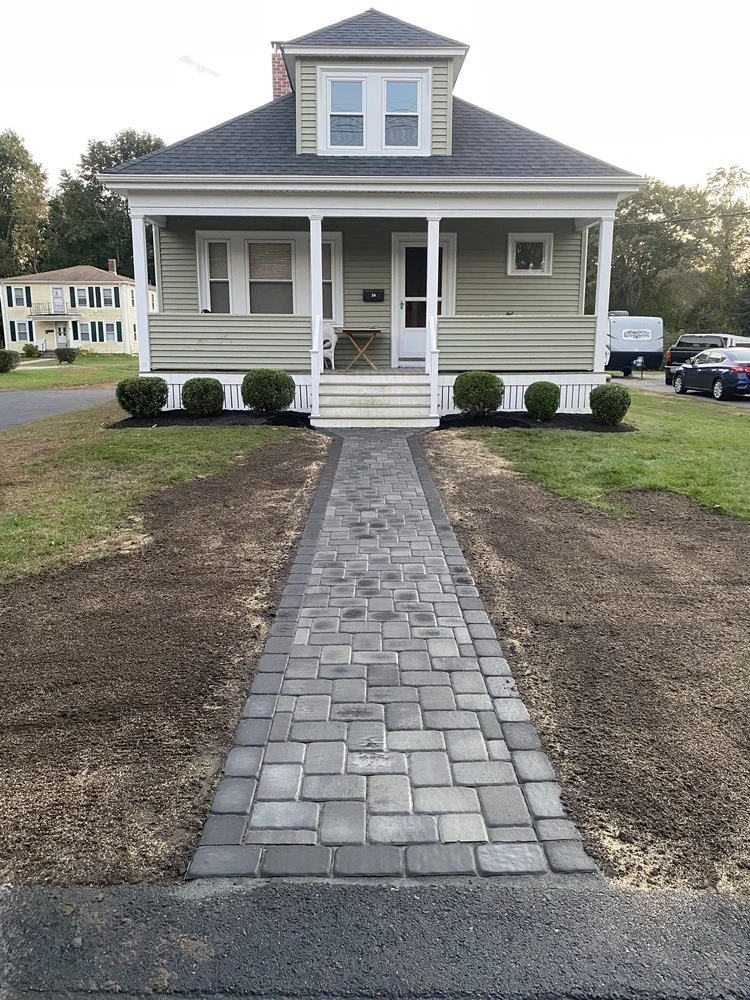
Paver repair in Georgia — pavers lifted, base corrected, bedding sand freshened, pavers reset. The result is indistinguishable from the original installation.
The Repair Process — Step by Step
A professional paver repair begins with identifying the scope of the settlement area — not just the visible low point, but the full extent of affected base material, which is often larger than the surface symptom suggests. The affected pavers are lifted and stacked in order (maintaining their orientation helps with reinstallation). The base aggregate is excavated to the depth of the original installation — typically six to eight inches — and the condition of the underlying subgrade is evaluated for any of the root, drainage, or compaction issues driving the settlement.
Once the cause is addressed — root removed, drainage path corrected, soft subgrade stabilized — fresh aggregate is placed and compacted in controlled lifts. Fresh bedding sand is screeded to a consistent thickness and tolerance. The original pavers are reset in their original pattern and orientation, with fresh polymeric joint sand swept in and activated. When properly executed, the repaired area is visually indistinguishable from the rest of the installation — which is the defining advantage that makes paver system repairability so significant compared to concrete repair.
Timberstone Landscape performs paver repair assessments and repairs throughout the Northeast Atlanta region — Gwinnett, Forsyth, Hall, Barrow, Cherokee, Fulton, and Walton counties — from our base in Grayson, Georgia. As a Techo-Bloc Preferred Contractor, we approach repairs with the same base engineering discipline we bring to new installations, which means addressing the cause rather than just the symptom. Our hardscaping services include repair assessment and execution, and our design-build process is available if your assessment reveals that a full renovation is the more cost-effective path.
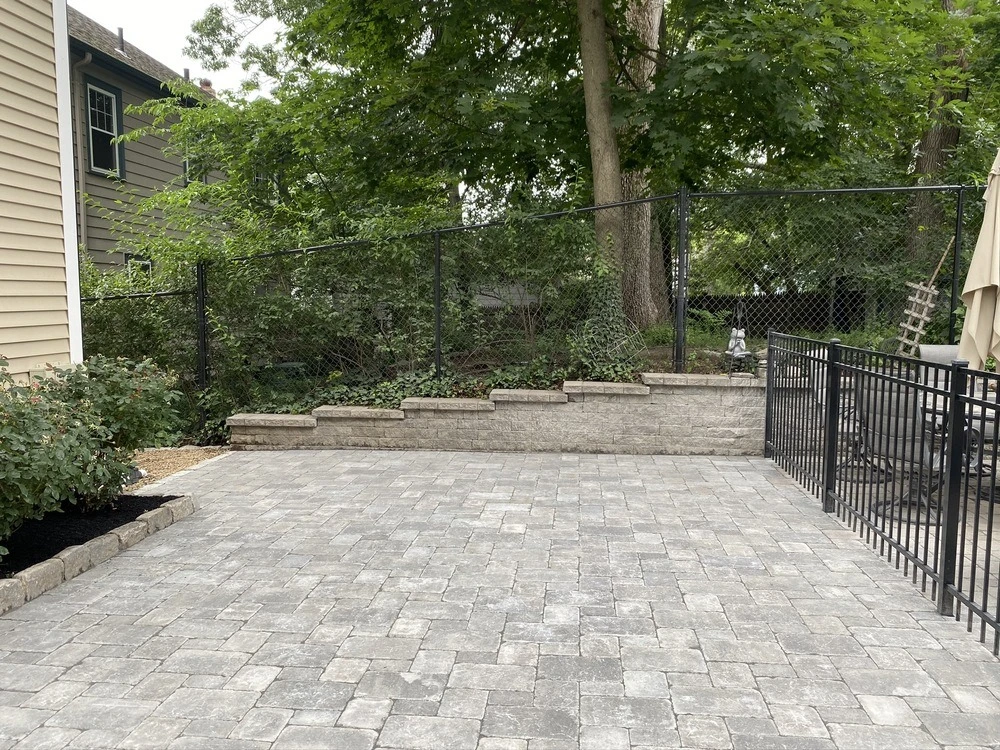
After repair — pavers reset, joints re-sanded, surface indistinguishable from the original installation. This outcome is only possible with pavers, never with concrete.
Assess Your Settled Paver Patio Before It Gets Larger
We serve all of Northeast Atlanta. Free repair assessment — we'll identify the cause, scope the repair, and give you an honest recommendation.
Request a Free ConsultationTimberstone Landscape is based in Grayson, Georgia and serves the greater Northeast Atlanta region within 40 miles: