
How Grading and Drainage Work Together on Georgia Properties — Why Bad Slope Causes Problems No Retaining Wall Can Fix
The most common landscaping mistake on Georgia properties isn't choosing the wrong plants or the wrong paver pattern. It's treating grading and drainage as separate problems — or treating them as afterthoughts to the project rather than the foundation it has to be built on. When grade and drainage aren't solved together, the consequences show up in every other element of the landscape: cracking patios, failing retaining walls, eroding beds, and standing water that invites pest and mold issues that have nothing to do with the original problem.
Georgia's soil makes this particularly consequential. The clay-heavy soils across Gwinnett, Forsyth, and Hall Counties shed water rather than absorbing it. When water sheds from one slope, it has to go somewhere — and without proper drainage management, that somewhere is the foundation of the house, the base of a retaining wall, or the saturated lawn that turns to mud every time it rains between May and September.
The SystemWhy Grading Has to Come Before Everything Else
Grading is the act of shaping the land's surface to direct water away from structures and toward appropriate discharge points. On any Georgia property with meaningful slope — which describes the majority of residential lots in the Northeast Atlanta region — grading is not an optional refinement. It's a structural requirement that determines whether every other landscape investment performs correctly or fails prematurely.
A patio installed on improperly graded ground will develop drainage problems regardless of paver quality or base depth. A retaining wall built without solving the drainage load behind it will move, crack, or fail outright — often within five to seven years on Georgia's clay soils. Grading has to precede hardscaping, not follow it, because once the stone is set, correcting the grade underneath requires demolition. This is why the Timberstone design process starts with a site analysis of the existing grade and drainage conditions before any other design conversation begins.
"A retaining wall can hold slope. It cannot fix water that is being directed into it from an unresolved drainage problem uphill."
Drainage Systems That Work With Georgia's Soil — Not Against It
The primary drainage solutions for Georgia properties with slope and clay soil are French drains, channel drains, catch basins, and swales — often used in combination. French drains — perforated pipe in gravel-filled trenches — intercept subsurface water moving through the soil and redirect it to an appropriate outlet. They're the correct solution for properties where water is accumulating in low areas without a clear surface path away. Channel drains at the base of paver patios or driveways collect surface runoff efficiently at the transition between hard surface and grade. Catch basins at low points collect and redirect water before it pools.
What doesn't solve Georgia drainage problems: a retaining wall without drainage infrastructure behind it. A wall built against unsupported clay soil will experience hydrostatic pressure buildup every time it rains heavily. That pressure, over time, pushes the wall forward. The failure mode is slow and then sudden — the wall performs adequately for several years, then the joint mortar fails or the base shifts and the entire section moves. We see this regularly on properties where a wall was built to hold slope without addressing the water that saturates that slope every storm season.
- Grading must be established before hardscaping — retroactive grading correction requires partial or full demolition
- French drains for subsurface water collection — essential on Georgia clay where water moves laterally through soil
- Channel and catch basin drains for surface runoff at hardscape transitions
- Retaining walls require drainage aggregate behind the wall face — clay soil without drainage creates hydrostatic pressure
- Swales and berms direct sheet flow away from structures on wider open properties
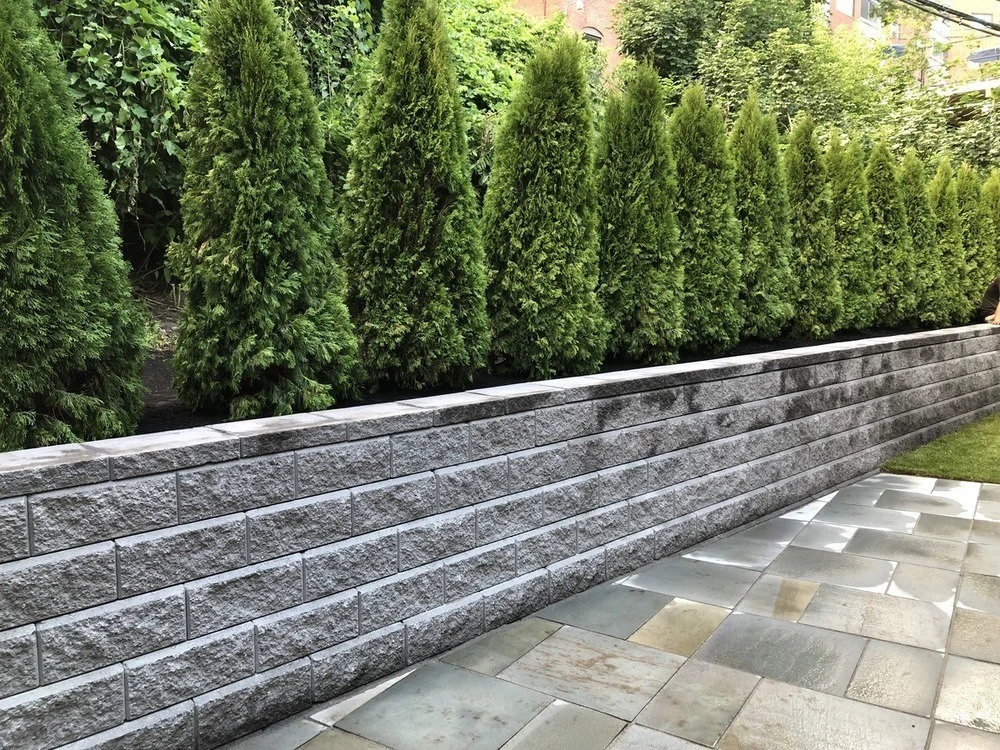
Timberstone evaluates grade and drainage as a single system — because that's what they are on a Georgia property.
When a Retaining Wall Is the Right Answer — and When It Isn't
A retaining wall is the correct solution when you need to hold a grade change, create a level terrace, or define a slope boundary for a hardscape element. It is not the correct solution for a drainage problem. A homeowner who builds a retaining wall to stop water from coming down a slope has not solved a drainage problem — they've created a potential structural failure point. The water that was running down the slope is now accumulating behind the wall and looking for somewhere to go. If the wall wasn't designed with adequate drainage aggregate and outlet pipes behind it, that water is going through the wall — or eventually pushing the wall forward.
Timberstone Landscape is based in Grayson, Georgia, and we assess grade, drainage, and structural needs as one integrated system on every site we evaluate. We serve Gwinnett, Forsyth, Hall, Jackson, Fulton, and surrounding counties. Every landscape project we build starts with understanding how the water moves across the property — because that understanding determines what gets built, in what order, and what will actually hold for twenty years. See our landscaping services or our hardscaping services to learn more.
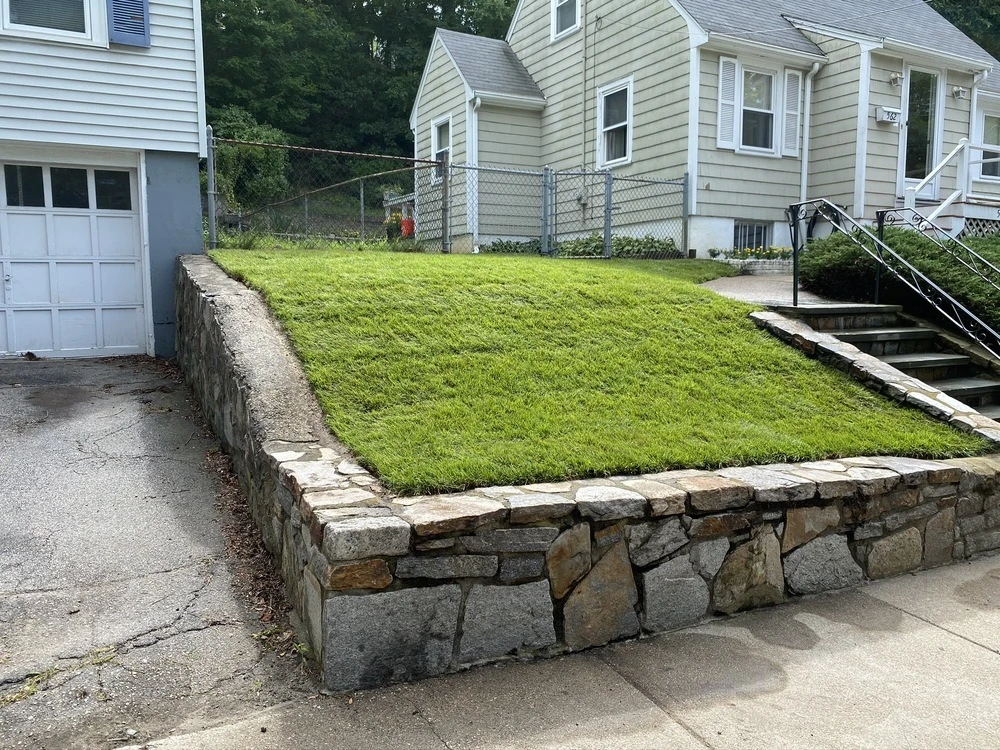
Grade and drainage solved together before anything is built — that's how Timberstone starts every project on a Georgia property with slope.
Grade and Drainage Solved Together — Not Separately
Free site evaluations. We assess slope, drainage, and soil conditions as one system — because they are one system.
Request a Free ConsultationTimberstone Landscape is based in Grayson, Georgia and serves the greater Northeast Atlanta region within 40 miles: