
Why Uplighting Trees and Structures Transforms Georgia Properties After Dark
A mature tree on a Georgia residential property is, during daylight hours, one of the most valuable visual assets on the lot. At night, without lighting, it disappears entirely into the darkness. Uplighting reclaims that asset after dark — not just by making the tree visible, but by transforming it into a dynamic focal point that defines the scale of the property and creates depth in the night landscape that no other technique can replicate.
The same principle applies to architectural structures. Pergola posts, columns, stone walls, retaining structures, and the faces of hardscape features all gain dimensionality under uplighting that they cannot communicate in flat, unlit darkness. When these elements are illuminated from below with well-selected beam angles and color temperatures, the night property becomes a composition — layered, scaled, and intentional — rather than a void interrupted by pathway fixtures.
Tree Uplighting TechniquePlacement Distance, Beam Angle, and Color Temperature for Trees
The most common uplighting mistake is placing the fixture too close to the trunk. A fixture at the base of a large tree illuminates only the bark directly above it, creating a narrow column of light that shows the trunk but misses the branching structure and canopy that give a mature tree its character. The correct placement distance is one-third to one-half of the canopy radius away from the trunk — for a tree with a 20-foot canopy radius, the fixture should be placed 7 to 10 feet from the base. This angle allows the light cone to catch the branching structure and project into the lower canopy rather than just grazing the trunk.
Beam angle selection follows tree type. A 30-degree narrow beam angle works well for columnar trees and narrow specimens — Italian cypress, upright hollies, and similar forms where the goal is vertical emphasis. A 45-degree beam angle suits most spreading shade trees — oaks, maples, dogwoods — where the goal is to fill the canopy structure with light rather than create a spotlight effect. Wider beam angles (60 degrees and above) are occasionally appropriate for very large specimen trees where a single fixture cannot fill the canopy, but multiple fixtures at different positions and angles typically produce a better result.
"Uplighting a mature Georgia tree is not about making the tree bright — it is about revealing the structure and scale that the tree already has, in a way that daylight actually obscures by making everything equally visible."
Uplighting Architectural Features — Columns, Walls, and Pergola Structures
Architectural uplighting operates on a different logic than tree uplighting. Where tree uplighting seeks to reveal organic form and canopy depth, architectural uplighting creates contrast, texture, and scale. Grazing light — a fixture placed very close to a stone or masonry surface and aimed almost parallel to it — highlights the texture and irregularity of the material in a way that dramatically shifts its perceived quality. A concrete block wall looks institutional under flat light. The same wall lit with a grazing uplight that rakes across its surface reads as substantial, textured, and intentional.
Pergola post uplighting adds vertical emphasis to a covered structure that can make an 8-foot post appear taller and the overall structure more substantial. Column uplighting at entries creates a formal, welcoming quality that is difficult to achieve through any other lighting technique. The fixture placement for architectural uplighting is typically within 6 to 18 inches of the surface being lit — close enough that the beam angle becomes almost irrelevant and the grazing effect dominates the visual result.
- Tree placement: 1/3 to 1/2 of canopy radius from trunk for branching structure coverage
- Narrow beam (30°): columnar trees, accent specimens with vertical form
- Medium beam (45°): spreading shade trees, multi-trunk specimens
- Warm vs. cool color temperature: 2700K for deciduous trees; 3000K for evergreens and stone surfaces
- Architectural grazing: fixture within 6–18" of surface, aimed nearly parallel for texture emphasis
- Column uplighting: single fixture per column, centered at base, aimed vertically upward
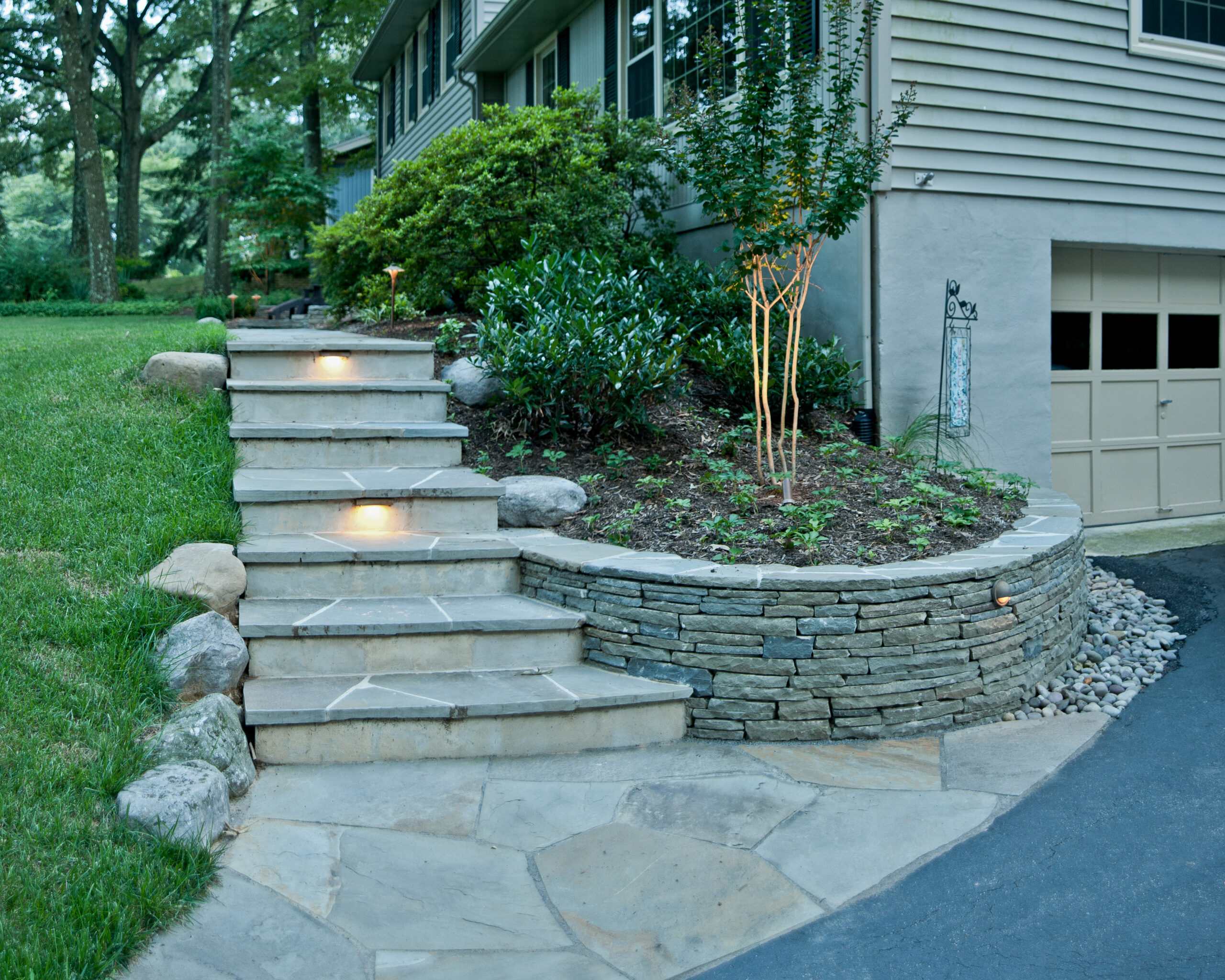
The combination of tree uplighting and architectural grazing creates a night landscape with depth, scale, and intentional composition — a property that reads as valuable from the street.
How Uplighting Integrates With the Full Lighting Design
Uplighting is the accent layer in a three-layer outdoor lighting system, and its full effect is only apparent when the ambient and task layers are also in place. An uplit tree in an otherwise unlit yard creates visual confusion — a bright element surrounded by darkness with no context. The same uplit tree within a system that establishes ambient light in the patio and task light at the cooking zone becomes a focal point that anchors one end of the outdoor composition and provides the visual depth that flat ambient-only lighting cannot produce.
Timberstone Landscape designs and installs complete outdoor lighting systems — including uplighting for trees, structures, and architectural features — throughout Gwinnett, Forsyth, Hall, Fulton, and surrounding counties in Northeast Atlanta. As a Techo-Bloc Preferred Contractor based in Grayson, GA, we develop lighting designs that respond to each property's specific tree locations, hardscape features, and outdoor living zones. Review our hardscaping services and our complete design-build process.
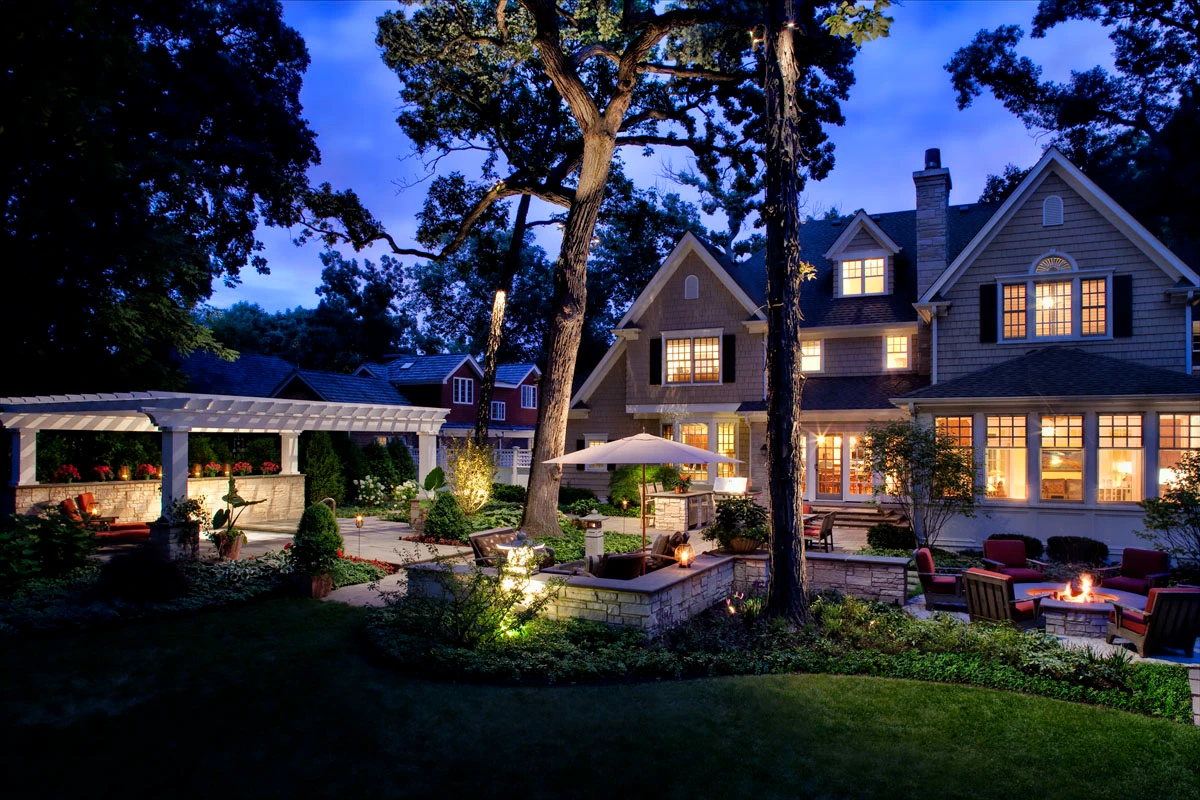
Uplighting reveals the scale and texture of trees and structures in ways that daylight cannot — it is the accent layer that makes a night landscape feel complete.
Transform Your Property After Dark
Free consultations. Serving Northeast Atlanta within 40 miles of Grayson.
Request a Free ConsultationTimberstone Landscape is based in Grayson, Georgia and serves the greater Northeast Atlanta region within 40 miles: