
Why Retaining Wall Projects in Lawrenceville, GA Fail — And What Proper Installation Requires
Retaining wall failure in Lawrenceville follows a predictable pattern. The wall looks solid at completion. It looks acceptable at year two. By year four or five, the first sign appears — a section tilting forward, a joint separating, erosion appearing at the base. By year seven, the wall is either actively leaning or has already fallen. The cause in nearly every case traces back to the same two installation shortcuts: inadequate drainage and insufficient base depth.
Gwinnett County's clay soil is one of the most demanding environments for retaining wall systems in the Southeast. It holds water long after a rain event, exerts significant lateral pressure when saturated, and experiences substantial volume change across Georgia's temperature range. A retaining wall installed without understanding these specific conditions is a wall being built to fail on a schedule its contractor won't be around to see. The homeowner will be.
The Failure CausesWhy Lawrenceville Retaining Walls Fail on Schedule
The leading cause of retaining wall failure in this market is the absence of a functioning drainage system behind the wall. When Georgia's heavy rain events saturate the soil retained behind a wall, that water exerts hydraulic pressure against the back face of the structure. Without gravel drainage aggregate and a perforated drain pipe to relieve that pressure, it accumulates with every rain event. The cumulative effect is a slow, continuous outward force that eventually overcomes the wall's resistance — typically within five to eight years on Lawrenceville clay-heavy lots.
"Retaining wall failure isn't sudden — it's a slow accumulation of drainage pressure that the wall eventually stops pretending it can resist."
The second cause is inadequate base depth. A retaining wall footing that sits in Georgia's active clay zone — rather than bearing in stable soil below that zone — will move with the soil as it expands and contracts across seasons. The movement is gradual and invisible until it becomes visible — which is when the wall has already shifted enough to compromise its geometry and its drainage path. Proper base depth on a Lawrenceville clay site requires excavating below the active zone and into bearing material, typically 18 to 24 inches below finished grade for most residential walls.
The third cause is incorrect wall geometry — specifically, insufficient batter (backward lean). A retaining wall must lean slightly toward the retained soil to counteract the forward pressure that soil exerts over time. A wall installed plumb, or nearly plumb, lacks this geometric advantage and relies entirely on its mass and anchor to resist the load. When drainage and base issues compound, even a properly battered wall has less margin for error. An improperly battered wall on a compromised base with no drainage is a failure waiting for the right rain event.
- Drainage aggregate and perforated pipe behind every wall — no exceptions on Gwinnett clay soil
- Base footing must reach stable bearing soil below the active clay zone
- Batter (backward lean) of 1 inch per foot minimum counteracts long-term soil pressure
- Geogrid reinforcement required for walls over 4 feet on clay soil in most configurations
- Wall base length must extend beyond wall height for adequate bearing surface
- Gwinnett County permit requirements for walls over 4 feet — verify before design is finalized
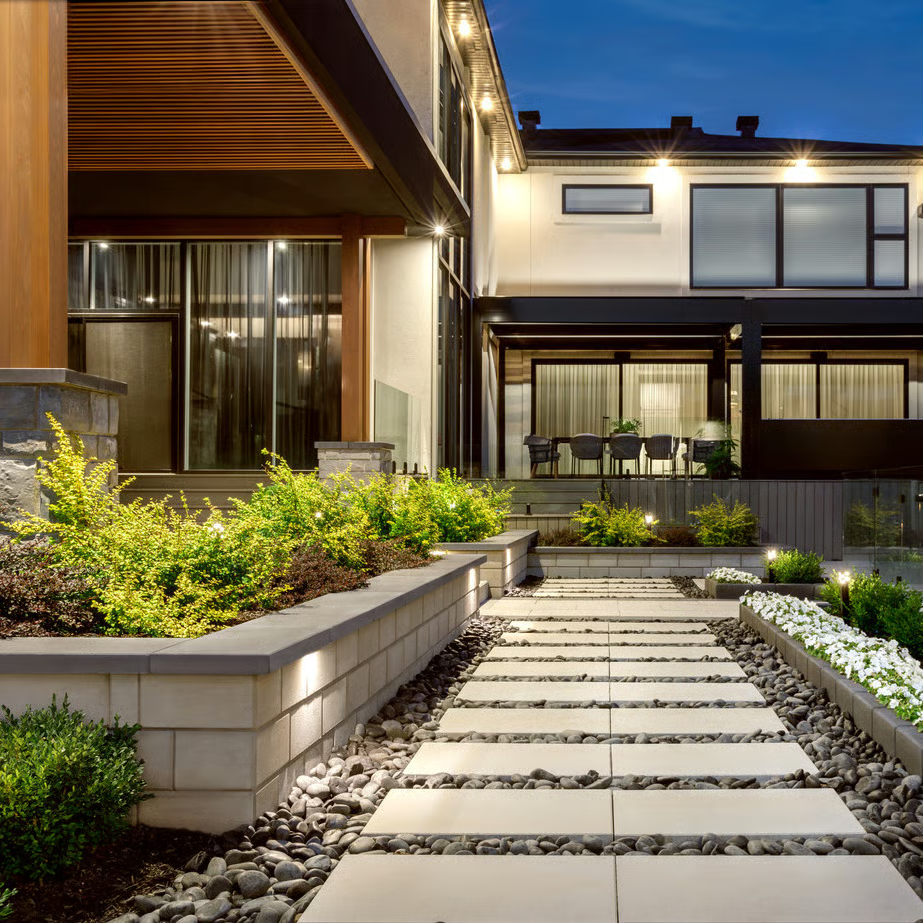
Retaining walls built to not fail — base engineering, drainage, and batter all specified correctly for Gwinnett County conditions.
What Proper Retaining Wall Installation Requires in Lawrenceville
Proper retaining wall installation in Lawrenceville starts with a site assessment that identifies the soil conditions, drainage patterns, and load requirements specific to your property. No two Gwinnett County retaining wall projects have identical conditions — slope angle, proximity to structures, drainage from adjacent properties, and the specific clay composition all vary and affect the engineering requirements.
The proposal that results from this assessment should specify the wall system by manufacturer name and product line, the base excavation depth, the aggregate drainage product behind the wall, the drain pipe specification, the batter geometry, and any geogrid reinforcement required. If a contractor proposes a wall price without visiting the site and without a specification this detailed, they're not engineering the project — they're gambling with your yard. Timberstone Landscape, based in Grayson, Georgia, is a Techo-Bloc Preferred Contractor and approaches every Lawrenceville retaining wall project with a full site assessment and a written specification that leaves no installation decision undefined. See our hardscaping services and our landscaping services.
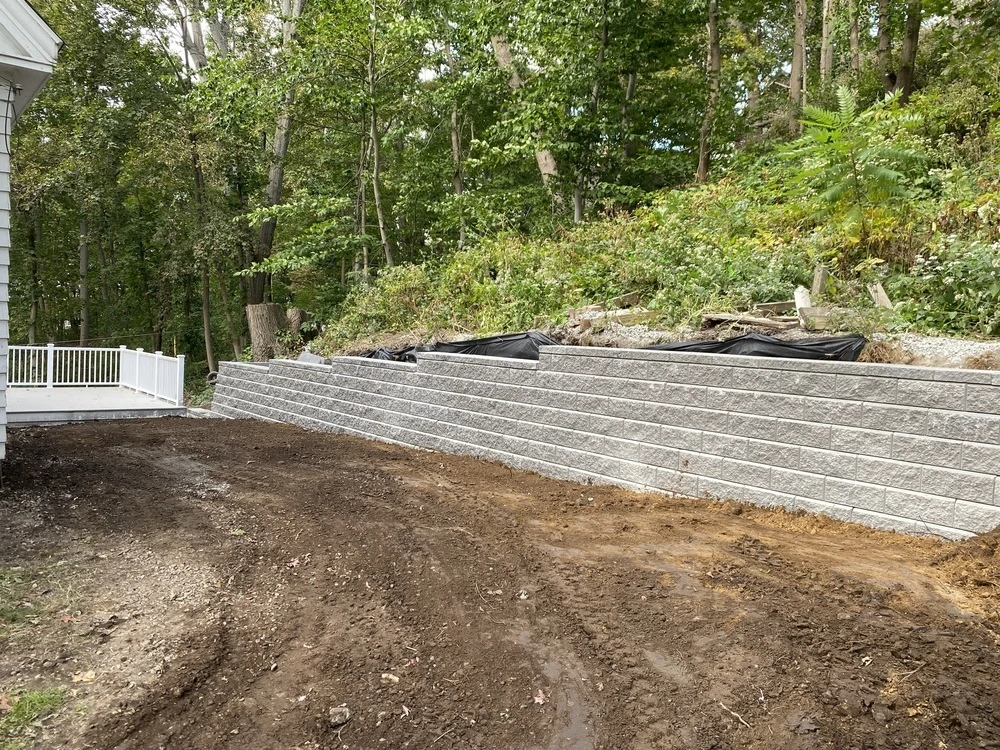
Retaining walls built to not fail — Timberstone Landscape serving Lawrenceville and Gwinnett County.
Retaining Walls Built to Not Fail — Lawrenceville Properties
Free structural assessments for Lawrenceville homeowners. We identify exactly why walls fail — and build to prevent it.
Request a Free ConsultationTimberstone Landscape is based in Grayson, Georgia and serves the greater Northeast Atlanta region within 40 miles: