
Why Dacula GA Properties With Slope Need Professional Retaining Walls
Dacula sits in the rolling terrain of northeastern Gwinnett County, where the land doesn't flatten out the way it does further south toward the metro. Grade changes of four to twelve feet across a single residential lot are common, and that topography shapes everything from how a yard drains to how much of it can actually be used. For many Dacula homeowners, a retaining wall isn't a design choice — it's a structural solution to a problem that only gets more expensive to ignore with each passing season.
The instinct to treat a retaining wall as a decorative addition misses the point entirely. On a sloped Dacula property, the soil is always under pressure — gravity is always moving it downhill, and every rain event accelerates that process. What looks like a gentle grade from the back porch can represent thousands of pounds of lateral soil pressure per linear foot. A wall that isn't engineered to handle that load doesn't just fail aesthetically. It fails structurally, often taking surrounding landscaping, hardscaping, and in some cases portions of the yard with it.
Engineering vs. StackingWhat Separates a Professional Retaining Wall From a Stacked One
The critical distinction in retaining wall construction is between walls that are designed to hold soil and walls that simply happen to be in front of soil. An engineered retaining wall starts with a calculation of the soil load it must resist — based on height, soil type, surcharge load (foot traffic, vehicles, structures above), and the drainage conditions behind the wall. From that calculation comes a foundation design, a batter angle, a drainage specification, and in many cases a geogrid reinforcement requirement.
A stacked wall — dry-laid stone or block without drainage or geogrid — can work perfectly well for ornamental purposes at heights of two feet or less. Push that wall to four feet without engineering it, and you're gambling with soil physics. At six feet, an unengineered wall is a structural liability. Georgia's clay soils hold water exceptionally well, which means hydrostatic pressure builds behind walls during rain events. Without drainage aggregate and perforated pipe behind the wall, that pressure has nowhere to go except into the wall face — and eventually through it.
"A retaining wall that fails doesn't give you a warning. One season it's fine, and the next spring it's leaning or has moved — taking everything behind it with it. The engineering work happens before the first block is set."
Dacula's Topography and the Wall Types That Perform Here
Dacula properties with significant grade changes typically need segmental retaining wall block rather than natural stone stacking, because the engineering properties of segmental block — consistent dimensions, calculated batter ratios, and integral connection to geogrid layers — make it possible to build walls that meet residential retaining requirements without poured concrete footings on most residential applications.
Walls over four feet in Gwinnett County typically require a building permit and in some cases a structural engineer's stamp. This isn't bureaucracy for its own sake — it's a recognition that walls of that height represent genuine structural loads on a property. Any contractor who suggests skipping the permit on a wall of that height is cutting a corner that protects you, not them.
- Walls over 4 feet require engineering review and in most cases a Gwinnett County building permit
- Drainage aggregate (crushed stone) and perforated pipe must run the full length behind every retaining wall
- Geogrid soil reinforcement is required at specific intervals for walls over 3–4 feet of exposed height
- Foundation base must be buried below frost line and set in compacted gravel, not soil
- Segmental block batter (backward lean) is engineered per block manufacturer specs — not by eye
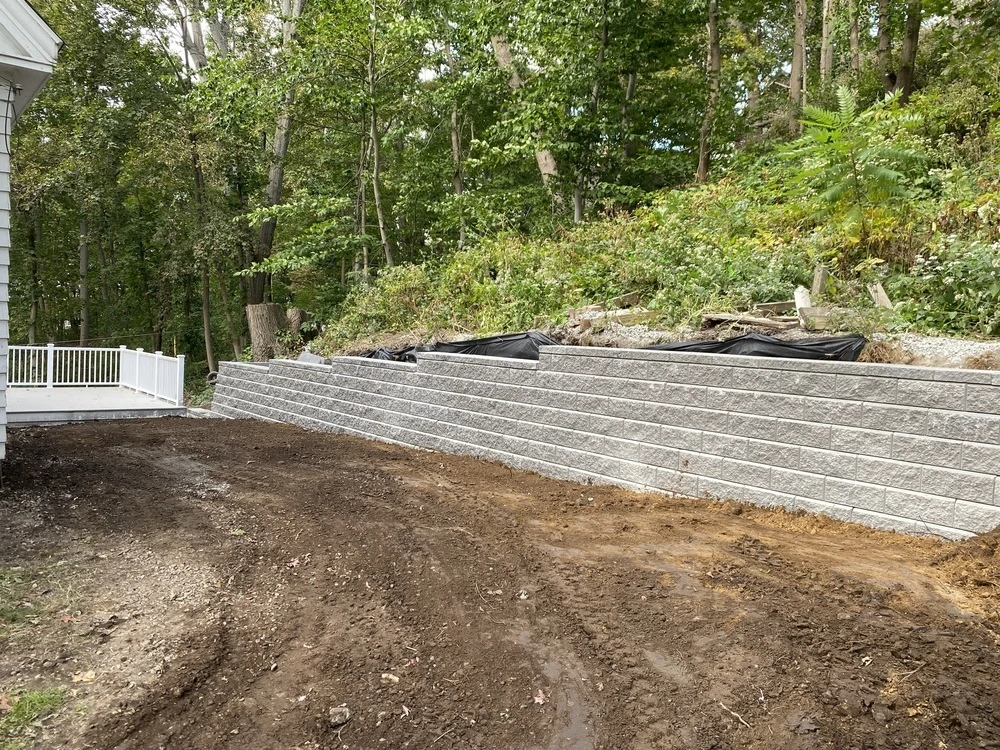
Proper drainage aggregate and geogrid reinforcement behind the wall face — invisible once complete, essential to long-term performance.
Turning a Grade Change Into Usable Outdoor Space
The design opportunity in Dacula's sloped properties is significant. A grade change that makes a yard unusable as a single flat lawn can become a series of terraced levels — each one a distinct outdoor room with its own function. A lower level patio for dining and entertaining, a middle terrace for lawn games, an upper level garden bed — all held by retaining walls that are as much landscape features as they are structural elements.
The conversation around retaining walls in Dacula has shifted in recent years. Homeowners who once viewed a slope as a limitation are increasingly seeing it as an opportunity for more interesting, layered outdoor design — and the wall systems available today, particularly from manufacturers like Techo-Bloc, offer surface textures and colorways that integrate naturally with home architecture rather than looking like utilitarian infrastructure.
Timberstone Landscape is based in Grayson, Georgia, and Dacula properties are a regular part of our Northeast Atlanta service area. As a Techo-Bloc Preferred Contractor, we engineer retaining walls to hold — not just to look good on installation day. Our hardscaping services include full retaining wall assessment, engineering coordination, and installation, and our design-build process ensures the wall integrates with your property's broader landscape plan.
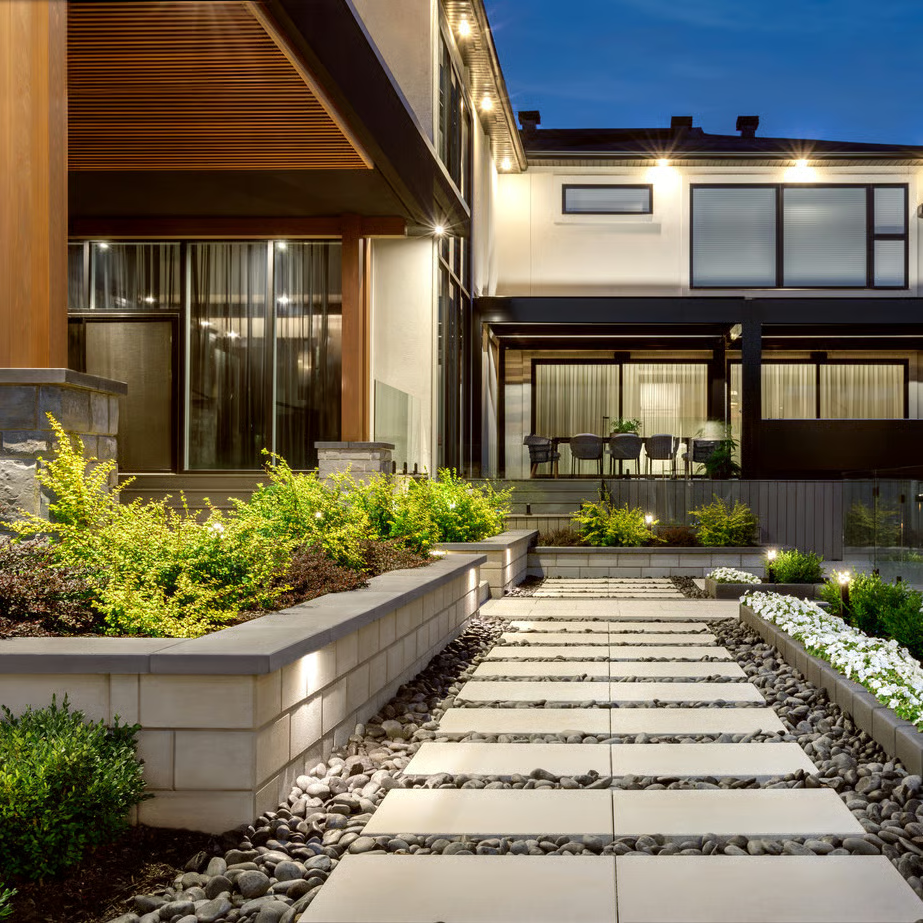
Terraced retaining walls transform a sloped Dacula backyard into a series of usable outdoor levels — structure and design working together.
Is Your Slope a Problem — or an Opportunity?
We assess Dacula properties throughout Gwinnett County. Free consultation to evaluate your grade, your soil, and your options.
Request a Free ConsultationTimberstone Landscape is based in Grayson, Georgia and serves the greater Northeast Atlanta region within 40 miles: