
Why Propane Fire Features Are Gaining Popularity in Northeast Atlanta Backyards
Propane fire features have moved from a niche option to the dominant fuel choice in Northeast Atlanta's outdoor living market — and the reasons are practical, not just convenient. For homeowners in Gwinnett, Forsyth, Hall, and the surrounding counties, propane offers a combination of placement flexibility, operating simplicity, and instant-on utility that natural gas and wood-burning alternatives cannot fully replicate. Understanding the trade-offs between all three fuel types helps homeowners choose the option that fits their property and usage patterns.
The shift toward propane reflects a broader change in how Northeast Atlanta homeowners think about outdoor fire features. A decade ago, wood-burning fire pits dominated — they were the default, partly because of tradition and partly because gas-line infrastructure for outdoor use was less common. Today, the overwhelming majority of fire features Timberstone installs are gas-powered, and within that gas category, propane has become the majority choice for a straightforward reason: most residential properties in the region do not have natural gas infrastructure at the back of the house where fire features are typically located.
Propane vs. Natural GasWhen Propane Wins and When Natural Gas Makes More Sense
Propane's primary advantage is placement flexibility. A propane fire feature requires only a propane tank — typically a 100-pound tank stored in a concealed cabinet within the fire feature structure or in an adjacent mechanical area. No gas line trench is required. This means a propane fire pit can be positioned anywhere on a patio without being constrained by the location of a gas line stub-out. For properties where the gas meter is on the opposite side of the house from the patio, propane eliminates a significant installation cost and complexity.
Natural gas is the preferred option when the existing gas line infrastructure runs close to the fire feature location, or when the homeowner is also installing an outdoor kitchen with a gas grill and side burner — in that scenario, running a single gas line to serve multiple appliances often makes more economic sense than managing multiple propane tanks. Natural gas also offers a lower long-term operating cost per BTU than propane, which matters for homeowners who use their fire feature frequently throughout the extended season. The decision between propane and natural gas is primarily driven by existing infrastructure and projected usage frequency — not by a fundamental quality difference in the fire experience itself.
"Propane gives you instant fire anywhere on the patio without trenching a gas line. For most Northeast Atlanta homes, that flexibility wins."
Why Wood-Burning Is Declining in Subdivision Settings
Wood-burning fire features have genuine appeal — the authentic crackle, the smell of burning wood, and the ritual of building and tending a fire are experiences that gas cannot fully replicate. For rural properties with abundant firewood and no adjacent neighbors, wood-burning remains a legitimate and appealing choice. But in Northeast Atlanta's residential subdivisions — which make up the majority of the region's housing stock — wood-burning fire features face practical limitations that gas does not.
Smoke management is the primary issue. In a subdivision where homes are positioned 20 to 40 feet apart, a wood-burning fire feature's smoke output is not contained to the homeowner's property. Wind shifts direct smoke toward neighboring homes, onto neighboring patios, and through open windows. HOA rules in many Gwinnett, Forsyth, and Hall County subdivisions either restrict or prohibit open wood-burning fires. Ash cleanup after every use adds friction that gas fire features eliminate entirely. For subdivision settings, gas wins on nearly every practical measure. Timberstone Landscape designs and installs propane and natural gas fire features throughout Northeast Atlanta as part of comprehensive patio and outdoor living projects. As a Techo-Bloc Preferred Contractor, we pair fire features with premium hardscape paving for integrated outdoor living results. See our outdoor features service page or our design-build process for how we approach each project.
- Propane: no gas line required, flexible placement, instant on/off, refillable on demand
- Natural gas: lower long-term cost per BTU, best when infrastructure is already nearby
- Wood-burning: authentic experience, but problematic in subdivision density settings
- HOA rules in many Northeast Atlanta subdivisions restrict or prohibit wood-burning fires
- Gas fire features (propane or natural gas) require no ash cleanup and no wood storage
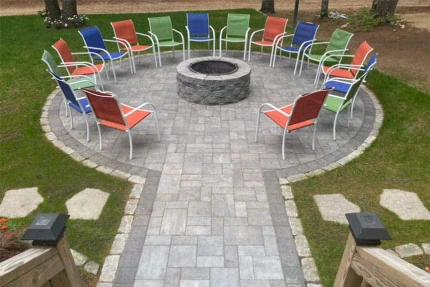
Propane fire features offer placement flexibility without gas line infrastructure — the most practical choice for most Northeast Atlanta residential properties.
Propane Tank Concealment and the Design Integration Question
The most common objection to propane fire features is the visible tank. A 100-pound propane cylinder sitting exposed next to a patio undermines the design investment of a professionally built fire feature. The solution — and the standard practice for any professional fire feature installation — is to conceal the tank within the fire feature structure itself or within an adjacent access panel cabinet built into the surrounding hardscape. When the tank is concealed properly, there is no visible indication that the fire feature is propane-powered. The operational experience is identical to natural gas: turn a valve, ignite the flame, adjust the output.
Timberstone Landscape's fire feature builds in Gwinnett, Forsyth, Hall, Fulton, DeKalb, and surrounding counties include tank concealment as a standard component of the design — not an afterthought. A fire feature that looks beautiful and functions simply is the goal, regardless of fuel type. Homeowners who are uncertain about propane versus natural gas for their specific property can discuss the infrastructure reality during the initial design consultation, where the right fuel choice becomes clear based on existing utility locations, planned feature placement, and budget.
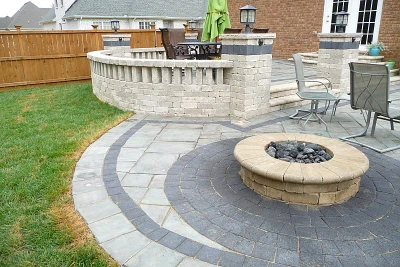
Professional fire feature installations conceal the propane tank within the structure — the result looks identical to a natural gas installation from every visible angle.
Install a Propane Fire Feature in Your Northeast Atlanta Backyard
Free consultations. Serving Northeast Atlanta within 40 miles of Grayson.
Request a Free ConsultationTimberstone Landscape is based in Grayson, Georgia and serves the greater Northeast Atlanta region within 40 miles: