
What Appliances Actually Survive Long-Term in a Georgia Outdoor Kitchen
Georgia's outdoor environment is more demanding than almost any other climate in the continental United States for outdoor kitchen appliances. The combination of intense summer UV, high humidity from May through September, daily thunderstorm moisture, and the occasional freeze-thaw cycling in late fall and winter creates a full spectrum of conditions that appliances must survive — not just perform in, but survive structurally over years of use. The appliances that fail early in Georgia outdoor kitchens are almost always ones that were not designed for this specific set of conditions.
The selection criteria that matter for Georgia are different from the criteria that matter in a showroom. In a showroom, a grill looks impressive if it is large, polished, and has many burners. In a Georgia outdoor environment after three years of use, the grill that is still performing and still looking good is the one built with the right stainless steel specification, with proper sealing at the burner ports, and with a firebox design that resists moisture accumulation. Understanding the specifications that determine long-term outdoor performance — not just initial appearance — is the starting point for making appliance selections that survive Georgia's climate.
Appliance SpecificationsStainless Steel Grade — The Most Important Specification
Not all stainless steel is the same, and the difference matters enormously in Georgia's outdoor environment. 304 stainless steel is the standard for residential outdoor-grade appliances — it contains 18% chromium and 8% nickel, providing excellent corrosion resistance in typical outdoor conditions. 316 stainless steel adds molybdenum, which provides superior resistance to chloride-induced corrosion — the specification used in marine and coastal applications where salt air is present.
For most Georgia outdoor kitchens, 304 stainless is appropriate and performs reliably with basic maintenance. The critical distinction is between commercial-grade 304 stainless at 16-gauge thickness or better — which is what outdoor-rated appliances use — versus the thinner 20 or 22 gauge stainless used in residential indoor appliances. Thinner gauge stainless warps under the thermal cycling of outdoor use, develops surface rust at flex points, and loses its finish quality significantly faster than commercial-grade material.
"The grill that fails in three years in a Georgia outdoor kitchen is not a grill that looked bad at purchase — it is a grill that was the wrong specification for the outdoor environment it was placed in."
Refrigeration, Storage, and Grill Design for Georgia's Conditions
Outdoor refrigeration is one of the most frequently misspecified appliances in Georgia outdoor kitchens. A residential refrigerator — regardless of how it is installed or housed — is not designed for outdoor temperature ranges. Georgia's outdoor temperatures swing from the mid-20s on winter nights to over 100 degrees in summer sun. A residential refrigerator's compressor is engineered for a stable indoor ambient temperature range. Outdoors, the compressor runs continuously in summer heat, fails early, and runs inefficiently year-round. True outdoor-rated refrigerators are designed with compressors and insulation rated for these ambient temperature swings, and they use significantly more power-efficient designs to manage the thermal load.
Grill design for Georgia's moisture conditions favors sealed burner designs over open tube burners. Open tube burners trap moisture, become infested with insects, and corrode from the inside out in Georgia's humid climate. Sealed or infrared burner designs resist moisture accumulation and maintain their ignition reliability over years of outdoor exposure. Door vs. drawer storage below the counter is a moisture resistance question: drawer storage provides better moisture drainage and better accessibility than hinged door storage in outdoor applications where water enters the enclosure regularly.
- 304 stainless steel at 16-gauge minimum — commercial-grade, not residential-grade specification
- Sealed or infrared burner grill design — prevents moisture accumulation in burner tubes
- True outdoor-rated refrigeration — compressor and insulation rated for outdoor ambient temperature range
- Drawer storage vs. door storage — better moisture drainage and access in outdoor applications
- Outdoor-rated wiring and junction boxes for any electrical components in the enclosure
- Weatherproof covers for any appliance that will sit unused for extended periods
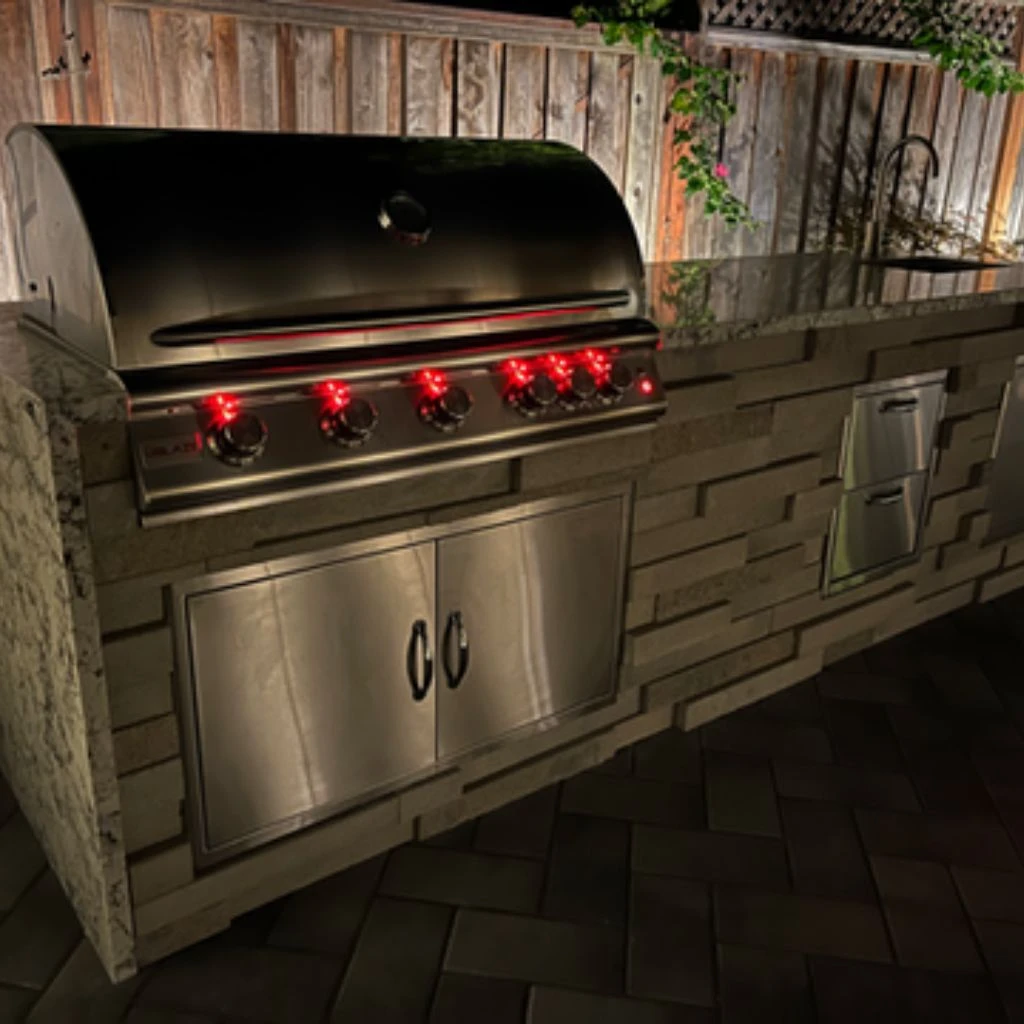
Commercial-grade outdoor kitchen appliances in Georgia — specified for the outdoor environment, not selected from a residential appliance showroom.
What Proper Maintenance Extends vs. What Specification Determines
Maintenance extends the life of properly specified appliances but cannot compensate for wrong specification. A commercial-grade 304 stainless grill that is cleaned after each use, covered when not in use, and serviced annually will perform reliably for 15 to 20 years in a Georgia outdoor kitchen. The same care applied to a residential-grade grill installed outdoors adds perhaps two years to its failure timeline. The specification determines the ceiling on performance; maintenance determines how close to that ceiling you stay.
Timberstone Landscape helps Georgia homeowners across Gwinnett, Forsyth, Hall, Fulton, Cherokee, and surrounding Northeast Atlanta counties specify the right appliances for outdoor kitchens that will perform for decades, not seasons. Our outdoor features service includes appliance selection guidance as part of the design-build process, and our design-build process ensures that appliance grade, enclosure design, and utility connections are specified together for Georgia's specific outdoor conditions.
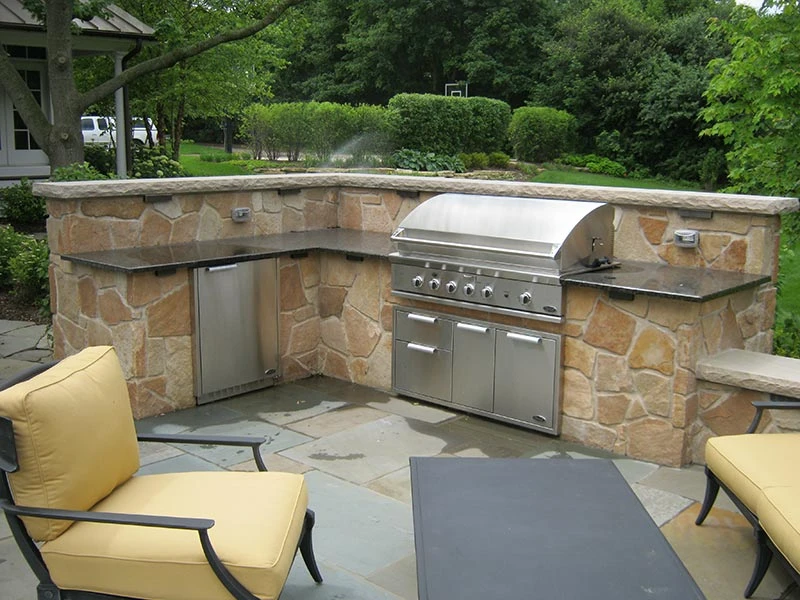
The outdoor kitchen that looks great after ten years in Georgia is the one where appliance specification matched the outdoor environment from day one.
Specify Outdoor Kitchen Appliances That Survive Georgia Long-Term
Free consultations. Serving Northeast Atlanta within 40 miles of Grayson.
Request a Free ConsultationTimberstone Landscape is based in Grayson, Georgia and serves the greater Northeast Atlanta region within 40 miles: