
How a Paver Walkway Transforms the Entire Approach to a Georgia Home
The front walkway is the first hardscaping element every visitor encounters — and the first one the homeowner uses every single day. It sets the quality expectation for everything that follows. A narrow concrete strip from the driveway to the front door communicates one thing; a wide, well-proportioned paver walkway with intentional material, edge treatment, and approach angle communicates something entirely different. The walkway is where curb appeal becomes curb credibility.
In Northeast Atlanta's competitive residential market, the walkway is frequently the highest-return hardscaping investment per square foot. It is visible from the street, it is photographed in every real estate listing, and it is experienced directly by every guest before they reach the front door. A paver walkway that reads as designed — as an intentional element rather than a utilitarian necessity — elevates the perceived quality of the entire property in a way that is difficult to achieve through any other single improvement.
Design PrinciplesWidth, Proportion, and the First Design Decision
The most common error in walkway design is under-sizing. A 36-inch walkway — three feet wide — forces guests to walk single-file. It communicates scarcity rather than welcome. A 48-inch minimum width allows two people to walk side by side comfortably and is the minimum standard for a walkway that reads as generous and intentional. For formal entries on larger homes, 60 to 72 inches reads as true luxury — a walkway that matches the scale of the architecture it serves.
Proportion relative to the home matters as much as absolute width. A wide walkway on a smaller home can look imposing; a narrow walkway on a large home looks like an afterthought. The starting point for any walkway design is the front door width, the home's facade width, and the distance from street or driveway to entry — and the walkway dimensions should be derived from those proportions rather than selected arbitrarily.
"A walkway that is sized to the home — not minimized to save material — is the single fastest way to communicate quality before anyone enters the front door."
Material Selection, Edge Treatment, and Approach Angle
Paver material selection for a front walkway must balance aesthetics with practicality. Techo-Bloc concrete pavers offer the widest range of tones, textures, and profiles for residential applications, and their dimensional consistency makes installation precise and repeatable. Natural stone — bluestone, granite, or limestone — reads as more organic and is appropriate for certain architectural styles, but requires more careful selection to achieve consistency. The key criterion: the material should complement the home's exterior palette, not compete with it.
Edge treatment is what separates a finished walkway from an unfinished one. Belgian block edging, soldier course borders, or cut-stone edge treatments create a defined boundary that visually contains the walkway and prevents edge deterioration as the adjacent turf grows and is maintained over time. A walkway without edge treatment — pavers laid directly against turf with no border — will show its lack of edge containment within two growing seasons as the grass grows into the joint material and the edge pavers shift laterally.
- Minimum 48" width — 60"+ for formal entries on larger homes
- Proportion sized to facade width and home scale, not minimized to save material
- Material that complements exterior palette — tone, texture, and profile selected together
- Belgian block or soldier course edge containment — not raw paver edge against turf
- Approach angle designed for natural movement from driveway or street to entry
- Step integration where grade change exists — steps should match walkway material exactly
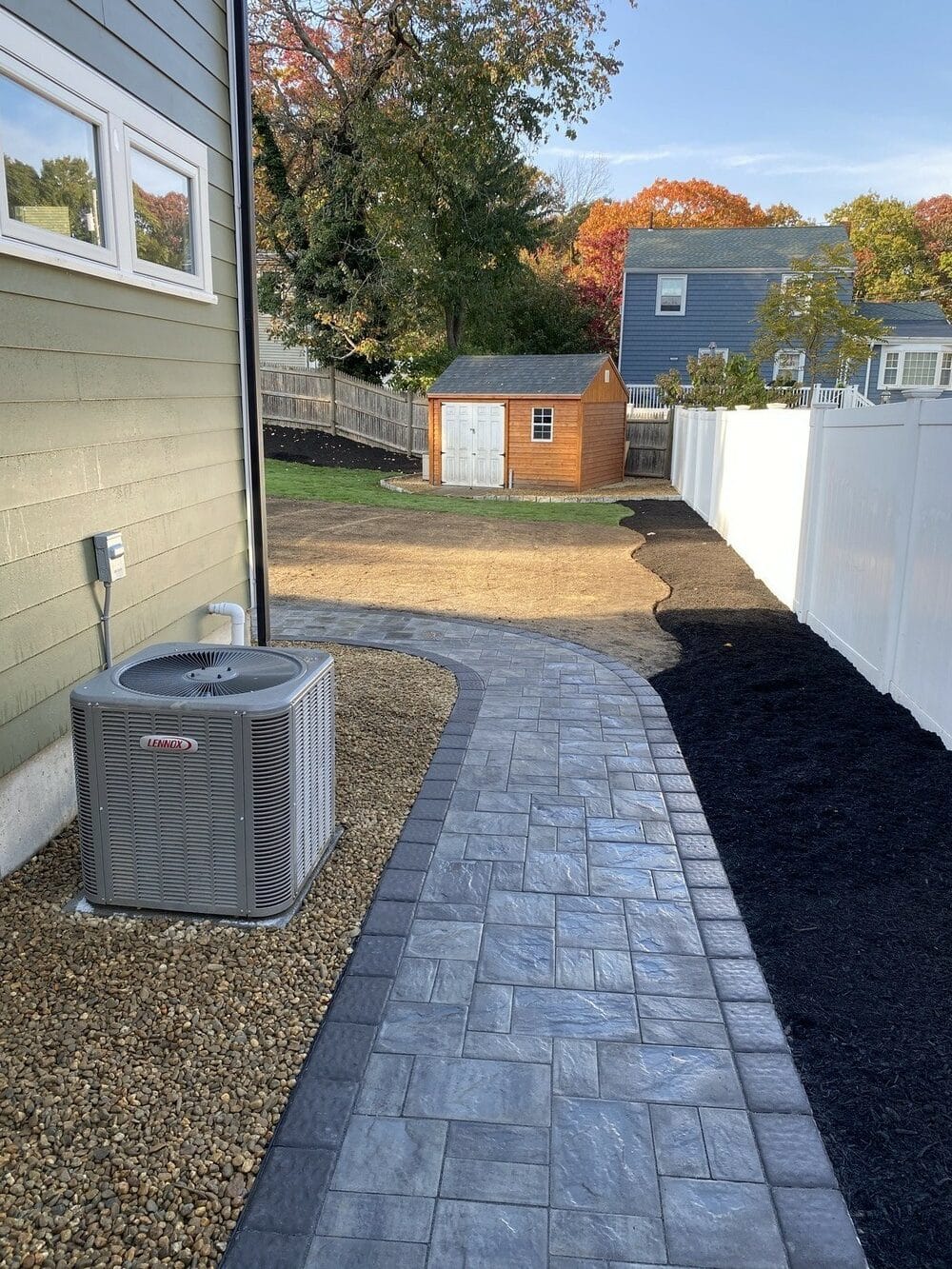
A properly proportioned paver walkway — wide enough for two, edged with Belgian block, sized to the home — transforms the front approach completely.
Step Integration and the Full Approach Sequence
Most Georgia properties have at least a minor grade change between the driveway or street level and the front entry. How that grade change is handled is as important as the walkway itself. Steps that are built from a different material than the walkway — precast concrete steps next to a travertine walkway, for example — create a visual discontinuity that undermines the design intent. Steps should match the walkway material precisely, with rise and run proportions that feel natural at a walking pace rather than steep or shuffling.
Timberstone Landscape serves Georgia homeowners across Gwinnett, Forsyth, Hall, Jackson, Fulton, and surrounding Northeast Atlanta counties with walkway design and installation that addresses every element of the approach sequence — from the street edge to the front door. Our hardscaping services include walkways, steps, and edge treatments as integrated elements, and our design-build process ensures material selections and proportions are resolved in design before installation begins.
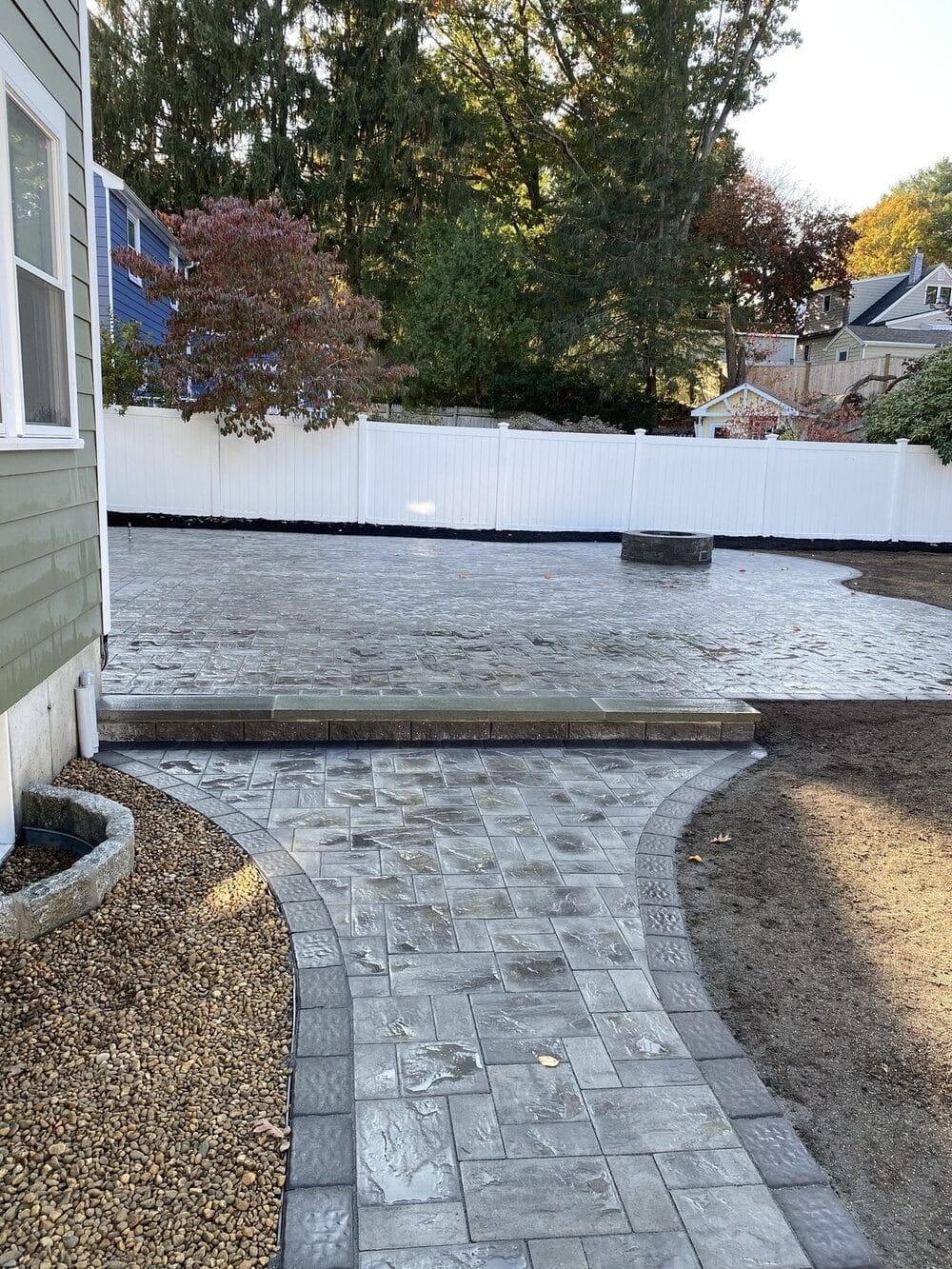
A complete front approach in Georgia — walkway, steps, and edge treatment designed as one system, scaled to the home it serves.
Design a Front Walkway That Changes How Your Home Is Perceived
Free consultations. Serving Northeast Atlanta within 40 miles of Grayson.
Request a Free ConsultationTimberstone Landscape is based in Grayson, Georgia and serves the greater Northeast Atlanta region within 40 miles: