
Why Sugar Hill GA Retaining Walls Need More Than Stacked Block to Last
Sugar Hill sits at the intersection of Gwinnett and Forsyth counties — a community that has grown rapidly over the past fifteen years and now includes a wide range of residential lot configurations, from tight subdivisions with minimal grade change to established properties on sloped terrain where retaining walls are a functional necessity. In this market, the gap between what constitutes a retaining wall and what constitutes a retaining structure that will remain intact for twenty years is not subtle. It is the difference between stacked block and engineered block wall construction — and that difference comes down to a handful of installation details that discount contractors routinely skip.
The DIY and low-bid retaining wall failure pattern in Sugar Hill and across Gwinnett County is consistent and predictable. Walls are built without deadman anchors. Drainage aggregate is not installed in the backfill zone. Geotextile fabric separating the aggregate from the native soil is absent. The batter — the slight backward lean that gives a wall structural stability — is too shallow or nonexistent. These omissions produce walls that look acceptable when new and begin failing within three to five years as hydrostatic pressure, soil saturation, and frost action find every structural gap the installation left open.
Engineering RequirementsWhat a Properly Engineered Block Retaining Wall Actually Requires
Deadman anchors are horizontal courses of block that extend back into the retained soil at regular intervals, typically every three courses or as specified by the wall system's engineering documentation. They create a mechanical connection between the wall face and the mass of soil behind it — without them, the wall is essentially a stack of blocks held in place only by their own weight and the friction between courses. For walls over two feet in height, deadman anchors are not optional. For walls over four feet in height, they are critical, and in many jurisdictions they are required by code.
Drainage aggregate and drainage pipe are the second non-negotiable component. Hydrostatic pressure — the pressure exerted by water-saturated soil against the back of a retaining wall — is the primary cause of retaining wall failure. The solution is to prevent water saturation by installing a drainage aggregate zone immediately behind the wall face and a perforated drain pipe at the base of the wall that collects and redirects water away from the wall system. Without this drainage system, every heavy rain in Sugar Hill saturates the retained soil, builds hydrostatic pressure, and applies force against the wall face at a level that the wall structure cannot sustain over time.
"A retaining wall without drainage is not a wall — it is a temporary barrier that is holding soil it cannot hold for long. The drainage system is what makes the wall a structure rather than a scheduled replacement."
Height Thresholds and When Engineering Is Required
Most residential retaining walls in Sugar Hill and Gwinnett County are built in the two-to-six-foot height range. Below four feet, a properly built segmental block wall — with correct batter, deadman anchors, drainage aggregate, and drain pipe — can be installed without a structural engineer's stamp in most jurisdictions. Above four feet, Gwinnett County typically requires an engineered wall design before a permit will be issued. Walls over six feet are generally considered engineer-required in all jurisdictions and involve more sophisticated structural calculations, deeper base courses, and more aggressive deadman anchor schedules.
For Sugar Hill homeowners considering a retaining wall project, the critical evaluation point is not the visual height of the existing slope — it is the excavated height that will be retained after the wall is built. A wall that appears to be three feet tall when you look at it from the downhill side may be retaining four feet of soil when measured from the base of the wall to the finished grade above. This distinction matters for structural requirements, permit requirements, and installation approach.
- Deadman anchors: required every three courses for walls over 2 feet in height
- Drainage aggregate: minimum 12" gravel zone immediately behind wall face
- Drain pipe: perforated pipe at base of wall, daylighted at each end
- Geotextile fabric: separates drainage aggregate from native soil to prevent migration
- Batter: minimum 1" setback per foot of wall height for structural stability
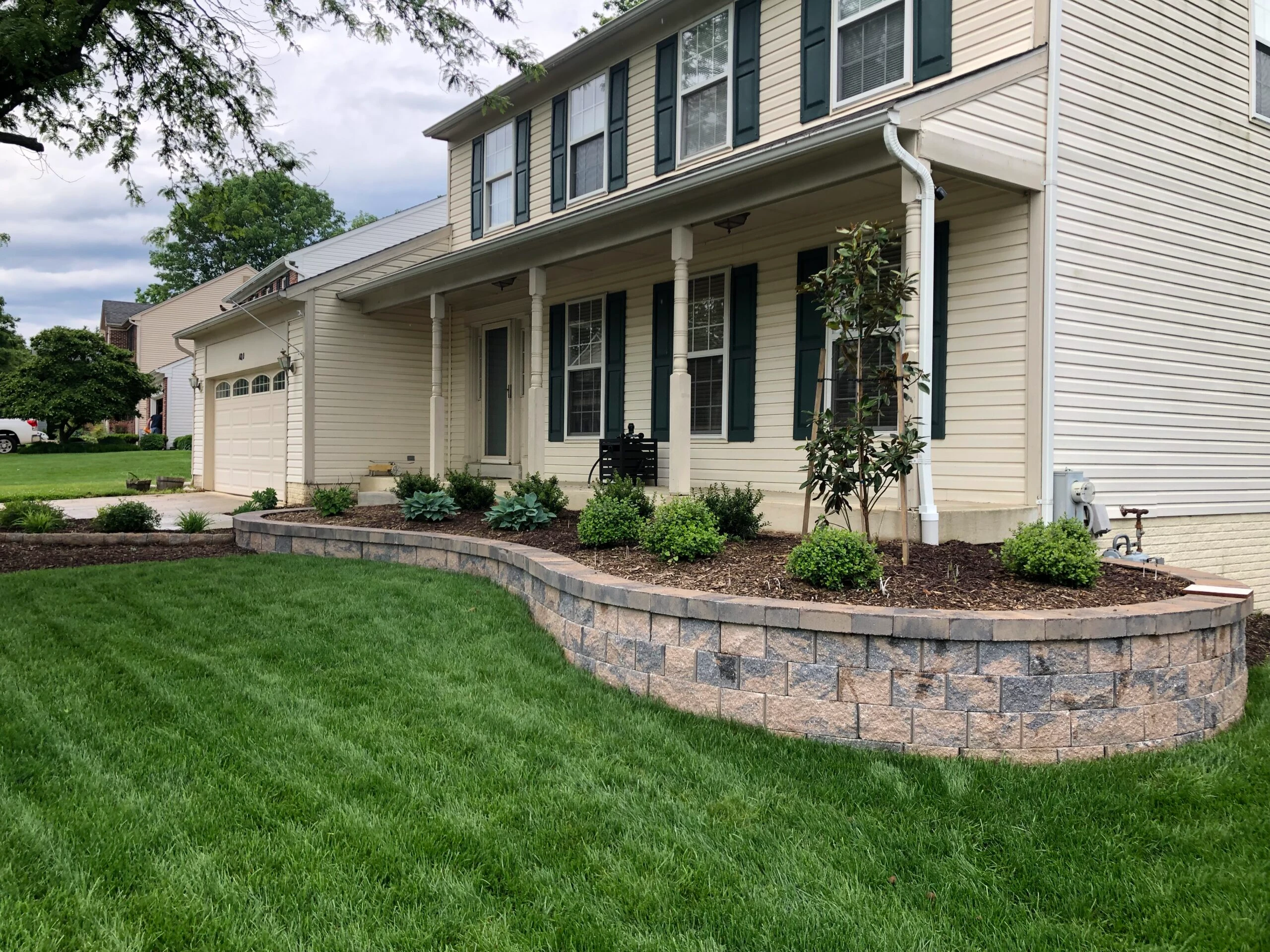
Properly engineered retaining walls in Sugar Hill include drainage aggregate, drain pipe, deadman anchors, and correct batter — not just stacked block.
What Happens When These Details Are Skipped
The failure timeline for improperly built retaining walls in Sugar Hill's Gwinnett County conditions is well-documented by the number of replacement projects in the area. Year one to two: the wall looks fine. Year three to four: the wall face begins to bow outward at the mid-height. Joints between courses open slightly. Efflorescence appears as water migrates through the wall face. Year five to seven: bowing is visible from a distance. In some cases, individual courses begin to displace. Year eight to ten: full section failure. The wall face collapses outward, retained soil runs down, and the homeowner is facing excavation, full demo, and reconstruction — at a cost significantly higher than a properly built wall would have cost originally.
Timberstone Landscape builds engineered retaining walls throughout Sugar Hill and the greater Gwinnett and Forsyth county area from our base in Grayson, GA. As a Techo-Bloc Preferred Contractor with specific expertise in engineered block wall systems, we build walls with all required structural components from the first course. Our hardscaping services include full retaining wall design, permitting support, and engineered installation. Our design-build process means the wall you get is the wall that was specified — no substitutions, no shortcuts.
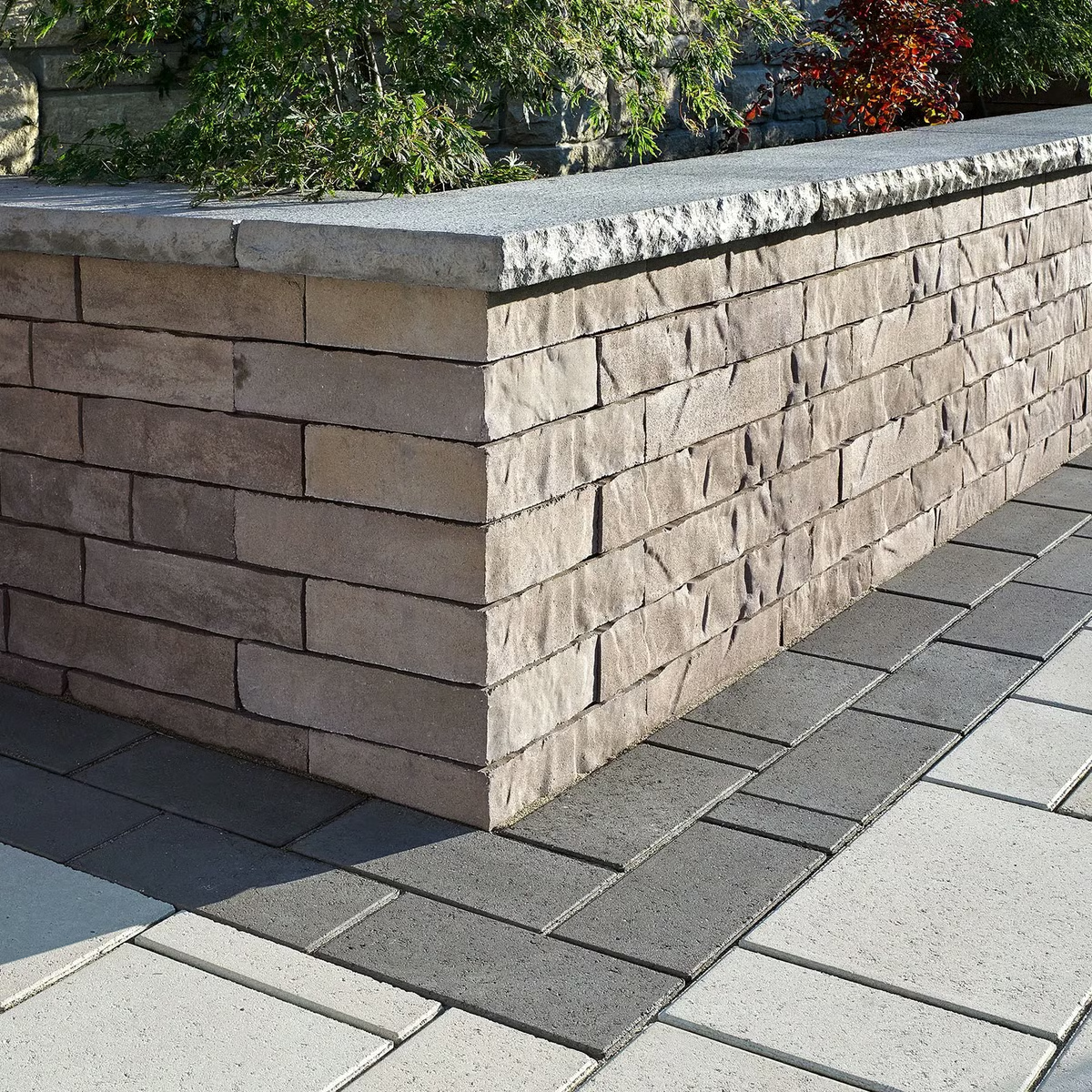
Multi-tier retaining wall systems in Sugar Hill require full structural specification — drainage, anchors, and batter at every tier.
Build a Retaining Wall in Sugar Hill That Actually Holds
Free consultations for hardscaping projects across Northeast Atlanta.
Request a Free ConsultationTimberstone Landscape is based in Grayson, Georgia and serves the greater Northeast Atlanta region within 40 miles: