
Why Counter Materials for Georgia Outdoor Kitchens Are Not All Created Equal
The outdoor kitchen counter is the most visible and most used surface in the entire installation. It is what guests touch, what food is prepared on, what drinks are set down on, and what the eye lands on when the kitchen is viewed from the dining or seating area. The material selected for that counter determines not just the visual quality of the kitchen but its maintenance requirements, its longevity in Georgia's outdoor environment, and whether it still looks like an intentional design choice in ten years or has degraded into something you would rather not show guests.
Georgia's outdoor environment eliminates several counter materials that perform well indoors or in milder climates. The combination of intense UV exposure, temperature swings from winter freezing to summer heat above 100 degrees, daily moisture from Georgia's thunderstorm season, and the occasional physical impact of outdoor use creates a performance environment that reveals material weaknesses faster than any indoor installation. Understanding which materials succeed and which fail in these conditions — and why — is the most important counter selection decision an outdoor kitchen builder in Georgia will make.
Material ComparisonGranite — Georgia's Most Proven Outdoor Counter Material
Granite has been used in outdoor applications for centuries. Its performance in Georgia's climate is well-documented and consistently positive. Dense, largely impervious granite — properly sealed — resists moisture absorption, handles temperature cycling without cracking, and maintains its appearance under UV exposure without fading or surface degradation. The sealing requirement is real: unsealed granite in a wet outdoor environment will eventually absorb staining from food, cooking residue, and the green algae that grows on outdoor surfaces in Georgia's humid climate. But sealed annually with a quality outdoor granite sealer, granite counters look excellent for 15 to 20 years with minimal maintenance.
The visual range of granite is broad enough to work with virtually any outdoor kitchen aesthetic. Darker granites — absolute black, emerald pearl, galaxy — provide high contrast against stainless appliances and warm-tone cabinet materials. Lighter granites — white ice, colonial white, river white — coordinate with travertine and limestone hardscaping and lighter architectural palettes. Granite edges can be profiled in eased, bullnose, or ogee profiles appropriate for outdoor use, without the delicate detail edges that chip in outdoor applications.
"Granite has been used outdoors in Georgia for generations — on gravestones, on building facades, and on outdoor kitchen counters. The material's outdoor performance record is not theoretical."
Porcelain — The Contemporary High-Performance Alternative
Large-format porcelain tile and porcelain slabs have become the most compelling alternative to granite for Georgia outdoor kitchens over the past decade. Porcelain is sintered ceramic — fired at extremely high temperatures to near-zero porosity. This means it does not absorb moisture, period. It does not require sealing. It is completely UV stable — the color will not fade or shift with years of direct sun exposure. And it handles Georgia's freeze-thaw cycling without cracking because it has no pore structure for water to enter and expand within.
The practical advantages of porcelain in an outdoor kitchen are significant. No sealing maintenance. No staining concern from food, wine, or cooking residue. No fading from UV. In a covered outdoor kitchen in Georgia, porcelain is arguably the lowest-maintenance premium counter material available. The installation requirement is important: large-format porcelain slabs are heavier and more fragile during installation than granite, requiring experienced installers and proper substrate preparation. A poorly installed porcelain counter — insufficient mortar coverage, improper substrate — will develop hollow spots and eventual cracking. Proper installation makes the difference between a porcelain counter that lasts indefinitely and one that fails within five years.
- Granite — excellent outdoor performer, annual sealing required, wide aesthetic range, proven longevity
- Porcelain — zero porosity, no sealing required, UV stable, modern aesthetic, requires experienced installation
- Concrete — custom profiles possible, requires sealing every 2-3 years, prone to staining without proper maintenance
- Tile with grout — grout joints fail in Georgia's freeze-thaw cycling, moisture penetration behind tile, avoid outdoors
- Indoor quartz — not UV stabilized, fades and discolors under direct sun exposure, not appropriate outdoors
- Indoor marble — porous, stains permanently, degrades rapidly in outdoor moisture conditions, do not use outdoors
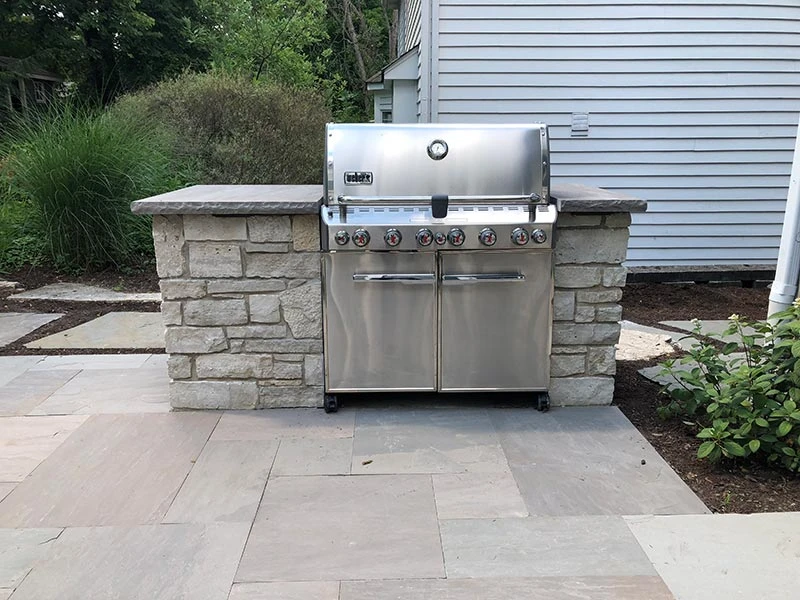
Counter material selection for Georgia outdoor kitchens — granite and porcelain both perform well; indoor quartz, tile, and marble do not survive the outdoor environment.
Why Concrete and Tile Underperform in Georgia's Outdoor Environment
Concrete counters have genuine appeal in outdoor kitchens — they can be cast in custom profiles, tinted to any color, and provide a distinct aesthetic that natural stone cannot replicate. The performance limitation is maintenance. Concrete is porous and requires sealing every two to three years in outdoor applications. In Georgia's outdoor environment, an unsealed concrete counter absorbs cooking stains, wine, and moisture readily. Between sealing cycles, the surface develops a patina that some homeowners appreciate and others find unappealing. Concrete also requires proper mix specification and curing for outdoor applications — thinner, indoor-spec concrete counters crack in Georgia's temperature cycling.
Tile with grout fails in Georgia's outdoor environment for a specific reason: grout. Grout joints absorb moisture, and in Georgia's mild freeze-thaw cycling — even the occasional brief freeze in winter — water that has saturated the grout expands and cracks the joint. Once the grout joint fails, water migrates behind the tile and against the substrate, eventually causing tile failure from the back. A tile outdoor counter in Georgia will require grout repointing within five years and tile replacement within ten — maintenance that granite and porcelain do not require. Timberstone Landscape helps homeowners across Gwinnett, Forsyth, Hall, Fulton, and the broader Northeast Atlanta region specify counter materials that match Georgia's outdoor conditions. Our outdoor features services include material specification guidance, and our design-build process ensures counter material is selected for long-term outdoor performance, not just initial appearance.
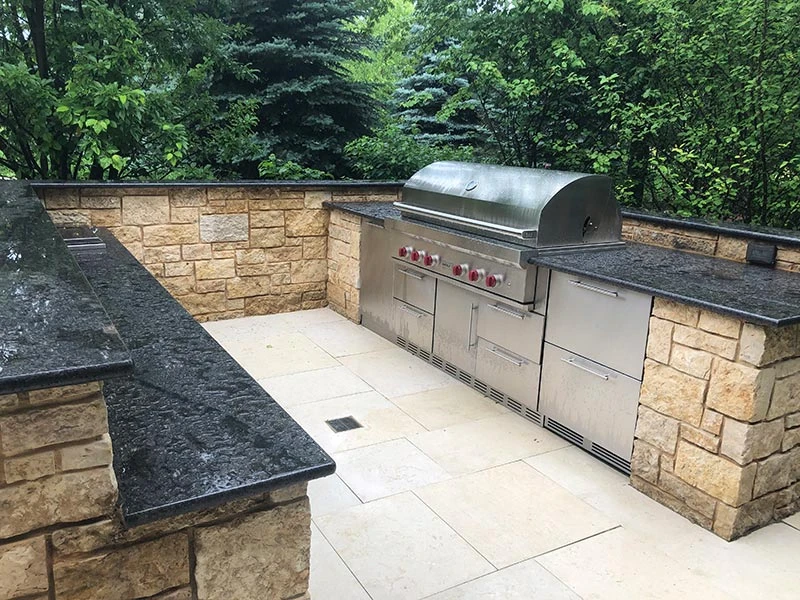
A properly specified outdoor counter in Georgia — the material choice that still looks good in ten years without the maintenance burden of inferior alternatives.
Specify the Right Counter Material for Your Georgia Outdoor Kitchen
Free consultations. Serving Northeast Atlanta within 40 miles of Grayson.
Request a Free ConsultationTimberstone Landscape is based in Grayson, Georgia and serves the greater Northeast Atlanta region within 40 miles: