
How to Plan an Outdoor Kitchen Layout That Actually Works for a Georgia Property
Most outdoor kitchen mistakes happen before the first block is ever set. Homeowners across Gwinnett and Forsyth counties invest significantly in outdoor cooking spaces only to find the layout conflicts with how they actually cook, where guests naturally gather, and what Georgia's summer heat demands of the space. Planning the layout is the job — everything else is execution.
An outdoor kitchen isn't just a grill on a patio. Done well, it's a fully functional cooking and entertaining zone that integrates with your home's traffic flow, your outdoor dining area, and the natural shade and wind patterns of your specific yard. Done poorly, it becomes a space you avoid because it's too hot, too cramped, or just doesn't work the way you imagined. The layout decision needs to come first — before appliances, before materials, before budget conversations.
Start With How You Actually Entertain
Behavior First, Blueprint SecondThe most common planning error is designing an outdoor kitchen around an idealized version of entertaining rather than how a household actually hosts. If you always cook while guests cluster nearby and talk, an island-style layout with bar seating on the guest side of the grill makes perfect sense. If you cook alone and prefer your guests at a separate table, a linear run along a wall may be more functional.
Walk through your current patio behavior before any design conversations. Where do guests gravitate? Where do you stand when grilling now? How far do you walk between the indoor kitchen and the outdoor grill during a cookout? These movement patterns should directly inform the layout configuration you choose. Georgia's outdoor entertaining season is long — this space will be used regularly, and a layout that fights your habits will get used less and less over time.
"The layout decision shapes everything downstream — appliance selection, material choice, traffic flow. Get it right first and the rest of the project becomes much easier to execute."
The Four Layout Configurations and When Each Works
Layout OptionsOutdoor kitchen layouts generally fall into four categories, each suited to different yard shapes, patio sizes, and entertaining styles. Understanding which configuration fits your property is the first real decision in the planning process.
- Linear (single run): Best for smaller patios or when the kitchen backs a perimeter wall. Efficient, cost-effective, and keeps the cooking zone contained. Works well when the grill, prep space, and storage all live along one axis.
- L-shaped: The most versatile configuration for most Georgia properties. Two runs at a right angle create natural zones — cooking on one side, prep and bar on the other — without requiring a large footprint.
- U-shaped: Maximum counter space and appliance capacity. Ideal for homeowners who cook seriously outdoors and want full prep, cooking, and refrigeration in one cohesive workspace. Requires a larger patio area.
- Island with seating: Bar-height counter on the guest-facing side turns the kitchen into a social hub. Works best when entertaining is the primary use and conversation with the cook is part of the experience.
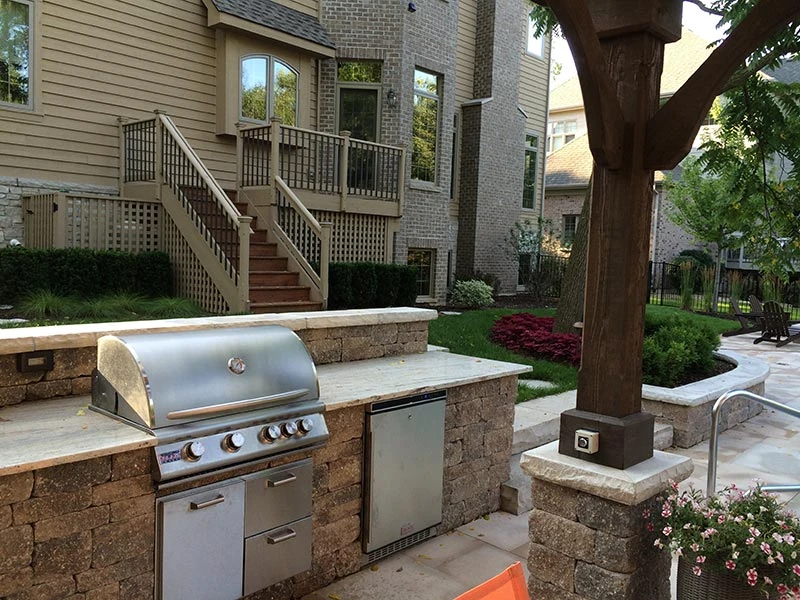
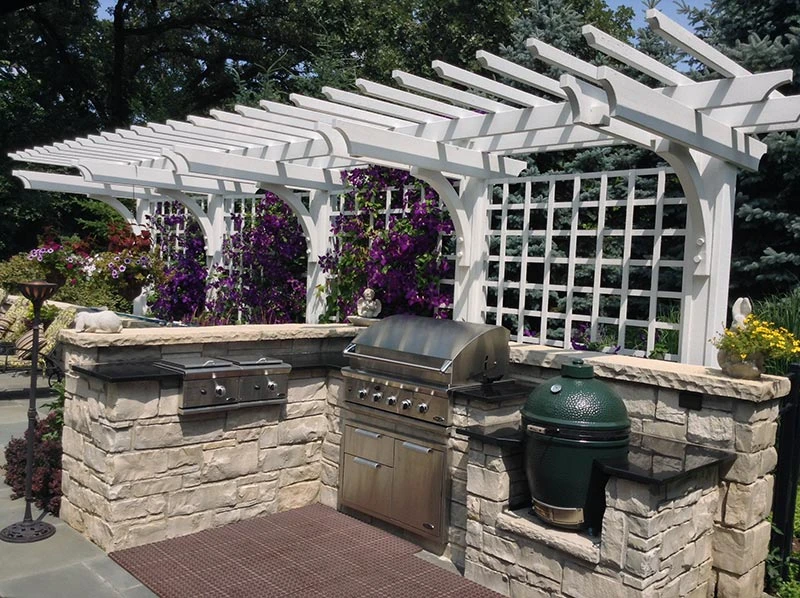
An L-shaped layout creates natural cooking and bar zones without demanding an oversized footprint — ideal for most Gwinnett and Forsyth county properties.
How Georgia's Climate Should Shape Your Layout Decisions
Climate-Informed DesignGeorgia summers are not neutral. The combination of high heat and humidity from June through August means your outdoor kitchen layout needs to account for sun exposure, prevailing winds, and proximity to shade structures. A grill positioned in direct afternoon sun on a southwest-facing patio turns cooking into an endurance test. A layout that traps smoke against a privacy fence makes every cookout miserable for guests.
Always orient the grill so that the cook faces away from the prevailing summer wind direction — in most of Northeast Atlanta this means the cook faces generally southeast. Position the grill at least eight feet from any roofline or pergola overhang to allow smoke to clear safely. If the kitchen will be under a covered structure, factor in ventilation from the design phase — not as an afterthought once construction begins.
Shade access matters almost as much as appliance selection in Georgia. A layout that keeps the cooking zone in afternoon shade — whether from a pergola, existing tree canopy, or architectural overhang — will be used far more often than one that bakes from noon to seven. This isn't about comfort preference; it's about whether the space gets used at all during peak summer months.
Why Timberstone Gets This Right
The Timberstone ApproachAt Timberstone Landscape, outdoor kitchen planning begins with a site analysis — not a brochure. As a Techo-Bloc Preferred Contractor (Techo-Pro), we have access to the full range of engineered outdoor kitchen systems and hardscape integration options that allow us to build layouts that function as well as they look. Victor and the Timberstone team have designed outdoor kitchens across Grayson, Lawrenceville, Buford, Suwanee, and throughout Gwinnett and Forsyth counties — and every project starts with the same question: how do you actually use this space?
We look at sun angles, prevailing wind, traffic patterns from the house, proximity to indoor kitchen access, and how the outdoor kitchen integrates with the rest of the hardscape design. The layout recommendation you receive from Timberstone is based on your specific property — not a catalog template. That's the difference between an outdoor kitchen you use every weekend and one that looks impressive in a photo but doesn't perform in real life.
Let's Plan Your Outdoor Kitchen Layout
Timberstone Landscape serves Grayson, Lawrenceville, Buford, Suwanee, Duluth, and throughout Northeast Atlanta. Get a free design consultation.
Get a Free Estimate