
How to Choose the Right Paver Pattern for Your Outdoor Space — The Decision Most Homeowners Get Backwards
Most homeowners choose a paver pattern by looking at photos and picking the one they like best. That's the backwards approach. The paver pattern that looks correct for your outdoor space isn't primarily a matter of aesthetic preference — it's determined by the size of the space, the architecture of the home, the direction of primary sightlines, and the proportions of the paved area relative to surrounding features. Get those factors right first, and the aesthetic almost selects itself.
The mistake of choosing pattern before context produces patios that look right in photographs but feel off at scale. A herringbone pattern that reads beautifully on a 200 square foot sample area becomes visually busy on an 800 square foot patio. A running bond that looks clean in a narrow walkway loses its directional quality in a wide open space without a dominant axis. Pattern selection is a spatial decision first and a preference decision second — and understanding that order changes how the final result reads.
Pattern Selection LogicLet the Space's Architecture Drive the Pattern
The most important single factor in paver pattern selection is the architecture of the home it connects to. Traditional and transitional homes read well with classic patterns — running bond, herringbone, and basketweave all have historical references that complement brick, stone, and traditional masonry. Contemporary and modern homes read better with large-format patterns, minimal joint variation, and clean linear arrangements that extend the home's geometric language into the outdoor space. Getting this relationship right produces a patio that looks like it belongs to the house — not one that was chosen independently.
"A paver pattern chosen without reference to the home's architecture produces a patio that looks applied. One chosen with that reference produces a patio that looks designed."
Scale, Proportion, and the Pattern's Visual Weight
Small-unit patterns — herringbone, basketweave, and tight running bond — have high visual complexity. In large open spaces, that complexity reads as texture, which can be appropriate. In smaller enclosed spaces or narrow walkways, the same pattern creates visual busyness that makes the space feel smaller than it is. Large-format patterns — ashlar, random coursed, and large-unit running bond — have lower visual complexity and work well in expansive spaces where a finer pattern would lose its character at distance.
Border courses and transition details matter as much as the field pattern. A well-executed border course — even a single course of contrasting color or orientation — frames the paved area and gives it visual definition. The field pattern and border work together as a composition, and the best paver installations are designed with both simultaneously. Timberstone Landscape brings pattern samples at full scale to every consultation, because the difference between how a pattern reads on a 6-inch sample and how it reads across 600 square feet is significant. We're based in Grayson, Georgia, and we install Techo-Bloc systems as a Preferred Contractor — which means material knowledge is part of every pattern recommendation. See our hardscaping services or our design-build process.
- Architecture first: traditional homes call for traditional patterns; modern homes call for linear, large-format
- Space scale: small-unit patterns read as texture at scale — large spaces often need larger format units
- Sightlines: running bond direction should align with or complement the primary view axis of the space
- Border courses: frame the field pattern and give the installation visual definition and intention
- Color blend: multi-color blends read better at larger scale; single tones read cleaner in tighter spaces
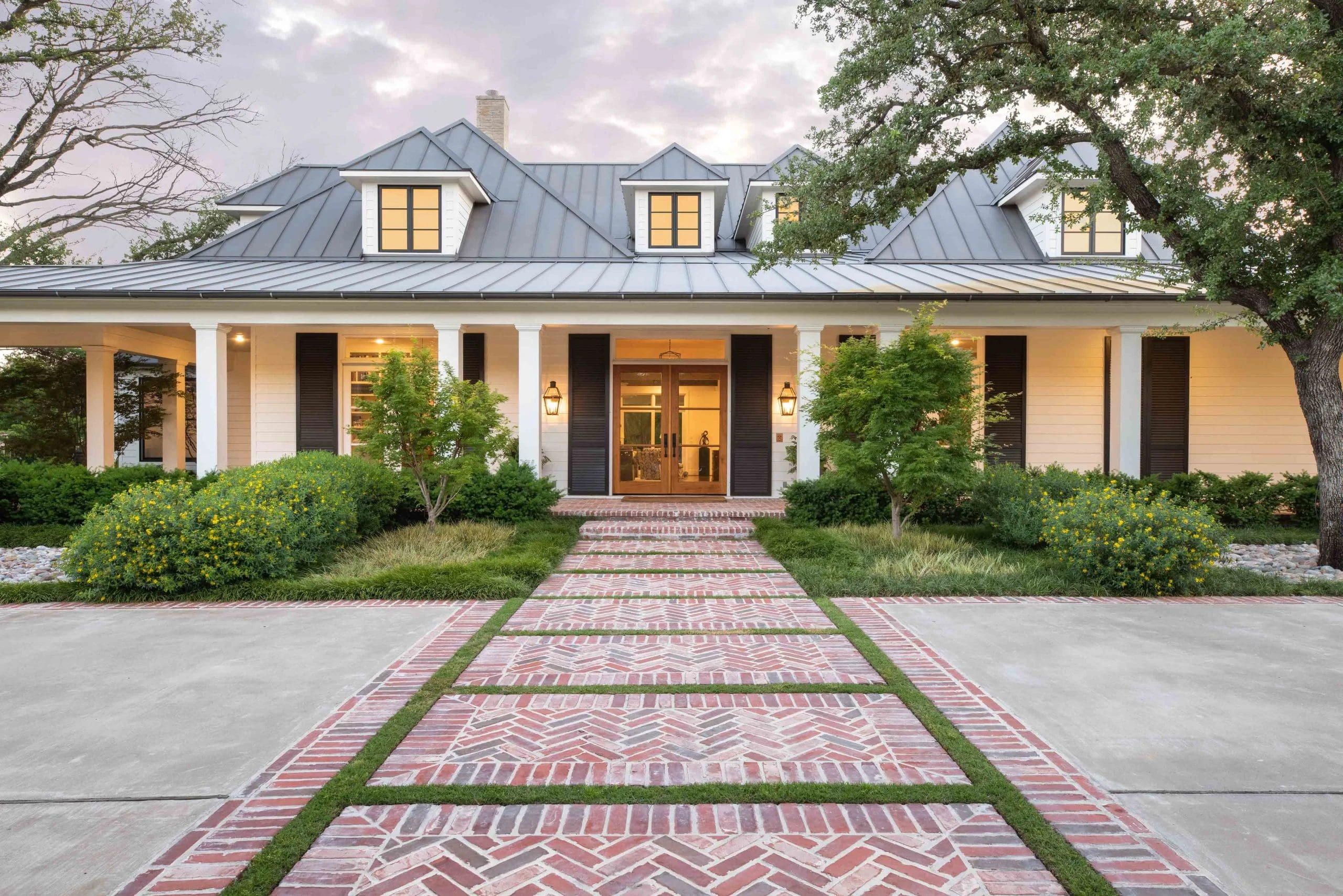
Paver pattern as a spatial and architectural decision — Techo-Bloc Preferred Contractor installation across Northeast Atlanta.
The Patterns That Work and When They Work
Running bond is the most versatile paver pattern. It works in virtually every application, reads cleanly at any scale, and installs efficiently without the cut complexity of diagonal patterns. The directionality of running bond — the dominant line running in one direction — needs to be oriented correctly relative to the space's primary axis. Running bond perpendicular to the house face makes a patio feel wider; running bond parallel to the house face makes it feel deeper. That single orientation decision changes how the space reads from inside the house.
Herringbone is the most structurally stable paver pattern because the interlocking diagonal arrangement distributes load in multiple directions. For driveways and high-traffic areas, herringbone is often the pattern of choice for structural reasons, not just aesthetic ones. For patios, herringbone's busy quality requires either large-format units or a large open space to read correctly. Diagonal herringbone — set at 45 degrees to the house — requires significantly more cuts at the perimeter, which increases installation time and waste. Straight herringbone parallel to the house reduces this significantly. The pattern conversation is worth having in detail before any installation begins.
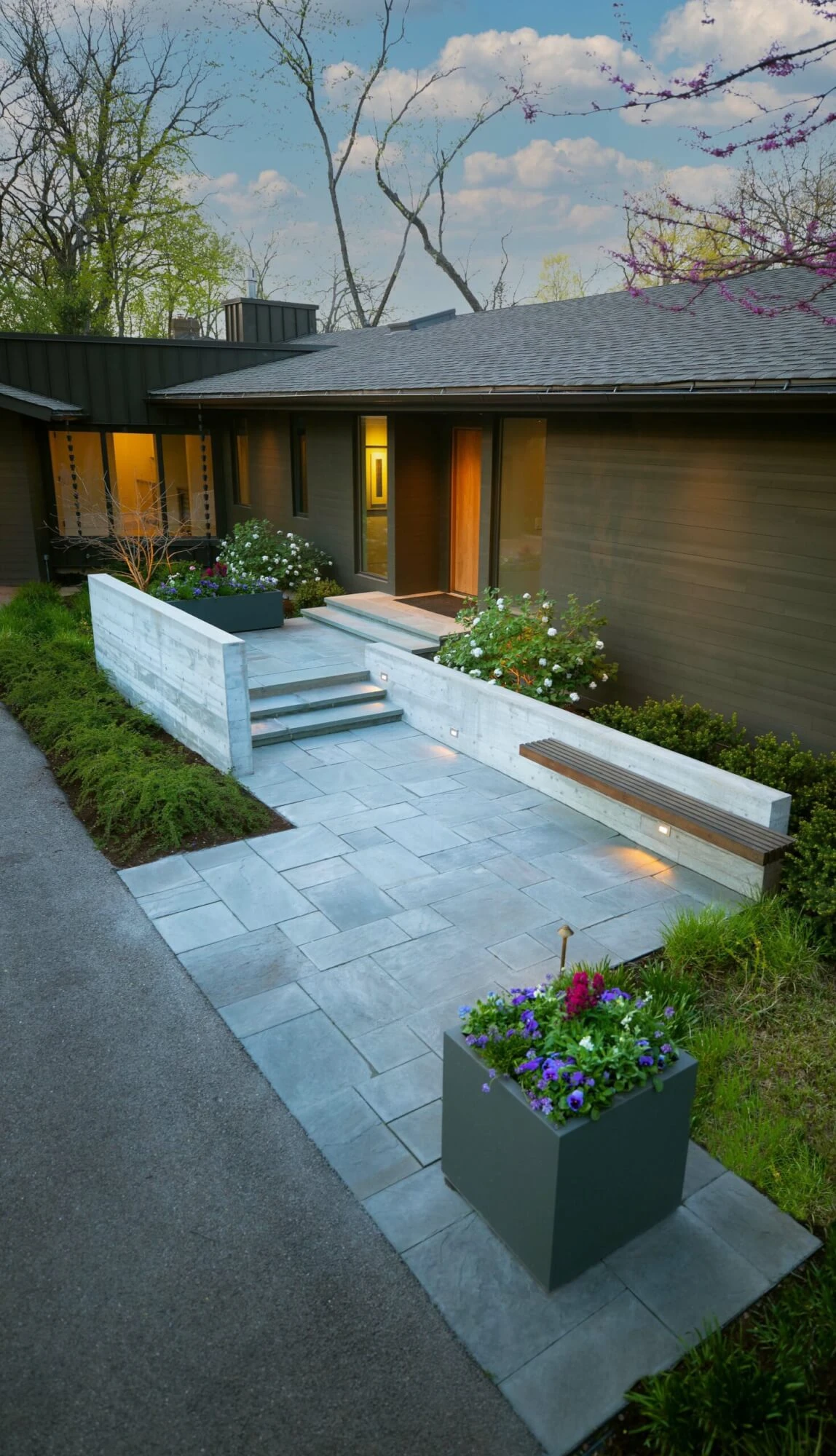
Pattern, border, and color blend chosen as a composition — before the first paver is placed.
Choose the Right Paver Pattern — Before You Commit
Free pattern and material consultations. We bring samples and walk you through the decision that most homeowners get backwards.
Request a Free ConsultationTimberstone Landscape is based in Grayson, Georgia and serves the greater Northeast Atlanta region within 40 miles: